
How Renting a Cordless Drill Turned Into an Audit of Two Websites
Year: 7, Month: 5, Week: 2, Day: 1
This whole story started with a perfectly ordinary household task — and somehow, I ended up getting paid too.
I needed a cordless drill, so I messaged Tools 4 Rent again.
(This takes place in Georgia, and the owner is Russian-speaking.)
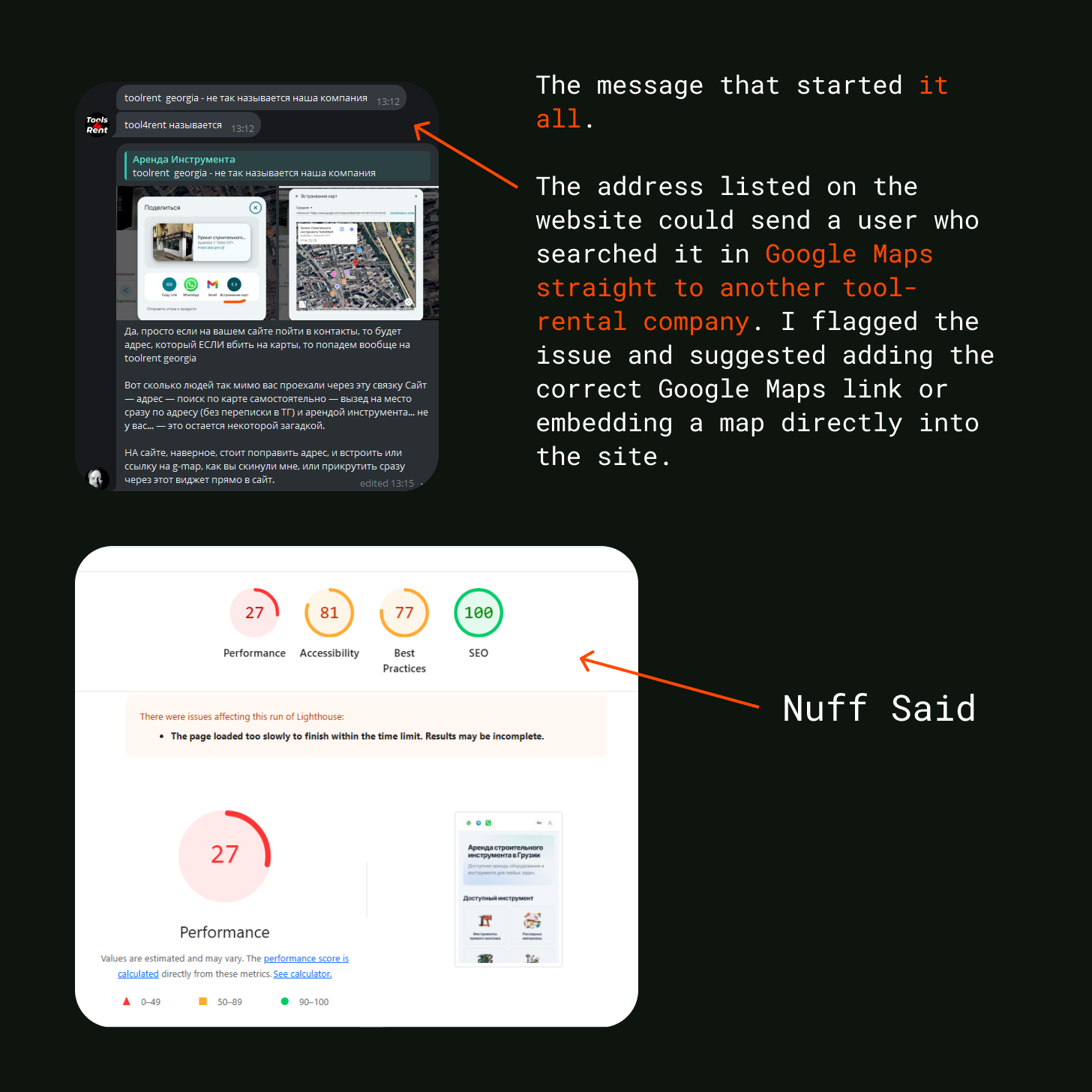
The website listed an address in Tbilisi. If you copied it into Google Maps yourself, the search took you to a different tool-rental company.
GOOD THING I RANDOMLY DOUBLE-CHECKED THE ADDRESS IN CHAT, OTHERWISE I WOULD HAVE DRIVEN TO THE WRONG PLACE.
That created a perfectly realistic user journey:
someone opens the website → goes to Contacts → copies the address → searches for it on the map → drives over to rent a tool.
How many people had already ended up at the wrong place this way is anyone’s guess.
I messaged the admin about it and suggested adding a correct Google Maps link or embedding a map directly into the website. The information was passed to the IT team, and then they asked whether I worked with websites and related tasks.
Anyway… one thing led to another, one conversation led to the next, and suddenly I had produced a 31-slide audit where every finding included context, evidence, an impact assessment, and a next step.
The client received a map of the current state of both websites, with a clear sequence of priorities: what already works, where users may lose clarity or trust, where the path to placing an order slows down, which issues affect booking and purchasing, what should be fixed first, and which areas could be developed next.
During the audit, we found the following — take a deep breath and read this in one go:
the mobile layout runs beyond the edge of the screen and breaks the booking flow, SMS login occasionally greets users with a JSON error, service cards show broken images, the catalogue falls into an unclear state after a filter is reset, tool availability by date remains unclear, order history exists without a fast way to repeat a rental, delivery lives on a separate information page and is not yet built into checkout, purchases jump into WhatsApp without a cart or checkout flow, the logo does not return users to the homepage, the mobile catalogue loses quick access to categories and contacts, stock information does not show how many units are actually available, too many orders still depend on manual chat, and both websites score 27 in Lighthouse mobile performance.
Then I put together a sequence of upgrades — read this whole thing on your second breath:
stabilise authentication and booking, fix mobile user flows, reduce front-end load, build delivery into checkout, show real tool availability and product quantities, shorten the repeat-rental journey, define the Best Tools sales model, create either a structured WhatsApp order flow or full e-commerce, add a rental cart, connect both websites through an “rent or buy” journey, create pages around real user tasks, build ready-made tool kits, add comparisons, compatible consumables, recommendations, and a managed technical foundation using Git and a private repository.
The audit also revealed a broader growth logic.
Tools 4 Rent can guide people through:
task → rental → tool kit → booking
Best Tools can develop the journey:
product → cart → delivery → payment
Together, both websites can help people choose the right way to solve the same task.
If the tool is needed for a one-off job, the user rents it through Tools 4 Rent.
If the tool will be needed regularly, the user buys it through Best Tools.
A Result You Can Apply
WHEN YOU BUILD A WEBSITE, DO NOT BE LAZY ABOUT RUNNING A PROPER UX/UI WALKTHROUGH.
Honestly, I still do not quite understand how this happened.
I sometimes spend way too long fucking around with the placement of a single button, or deciding whether headings in a desktop layout should align left or right. Then I switch to mobile and ask whether, for some reason, that element should be centred instead.
And here the developer apparently just did not give a fuck about any of it…
The wildest part is that the business is still afloat.
That probably says more about the current market conditions. Once a more attentive competitor shows up, they may scoop up some of the leads and customers this business is fucking losing — and take a bite out of its modest little revenue stream.
The market never sleeps.
Neither should you.