
A small result in the numbers — a big step for the whole brand
Year: 7, Month: 2, Week: 4, Day: 7
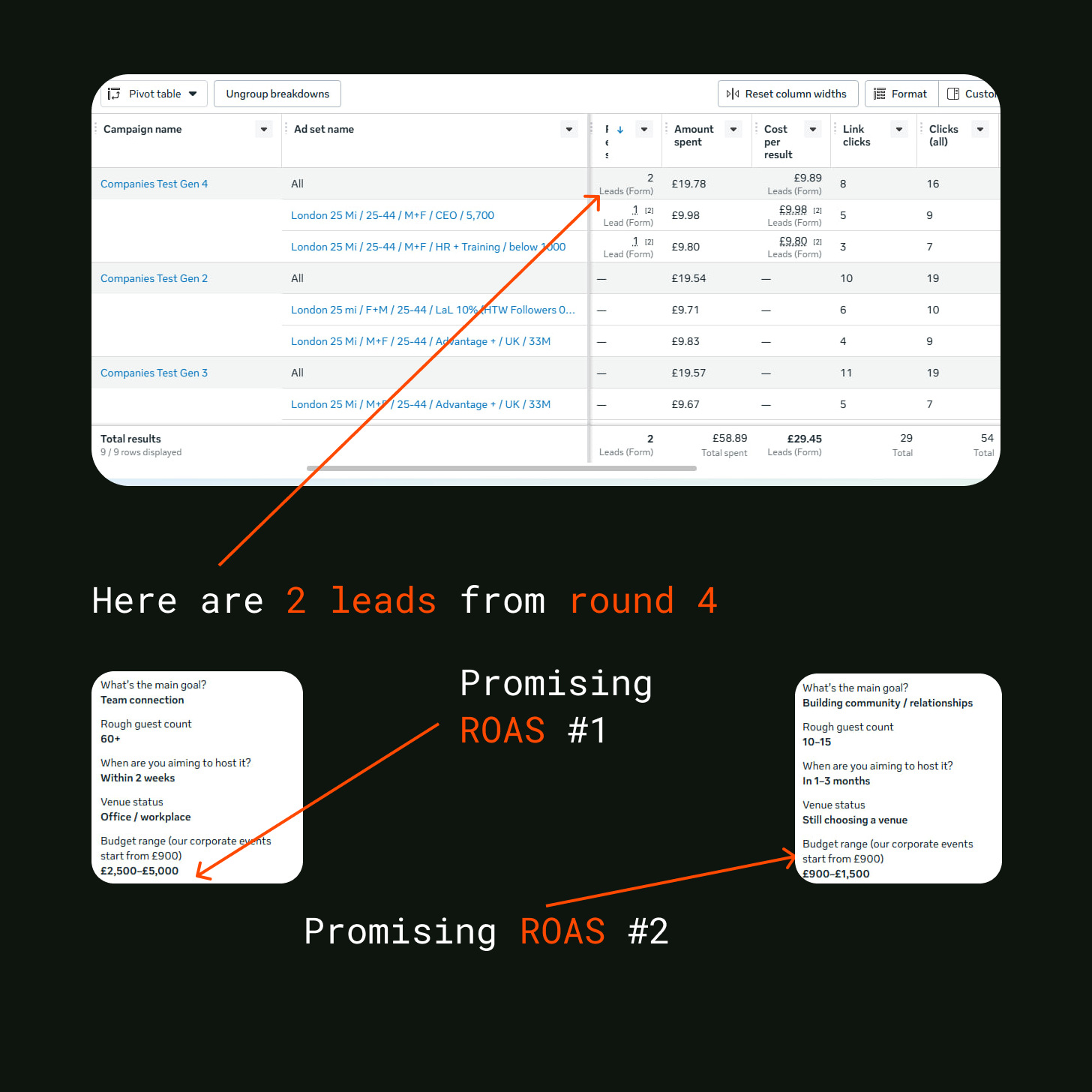
For How To Wine, these two leads are a major breakthrough.
Up to this point, the brand had only been actively promoting and selling B2C events. There was at least some working skeleton there: how to think about the product, how to present it, how to talk to the end customer. But B2B existed more as an intention. There was a pinned post on Instagram about it, sure. The brand wanted to move in that direction and sell more corporate events, but there was no accumulated experience and no clear understanding of how to do it at all.
So the work started far away from ads.
First, the client defined the task: I want to sell into B2B. Then I sat down to figure out what that could even look like for this brand. I put together an initial strategy, prepared interview questions, and held a call where we tried to untangle what should actually count as a B2B offer here, who exactly we should be selling to, and what kind of lead should even be treated as valuable.
At that point, one thing became clear: this direction could not be treated as one blob. There were at least two different demand classes inside it — personal events and corporate events — because the starting budgets were different, which also meant slightly different lead qualification logic.
After that, I strengthened the framework with GPT deep research. In other words, I first extracted the living raw material from the client, then attached a research layer to it. I read through that material, cleaned out everything that did not match the brand’s reality or was not executable under the current constraints — that was the added value on my side. Then I turned all of it into a working plan that could actually be launched.
The plan was strong. But now I had to build some kind of MVP conversion funnel out of whatever was already there.
And it had to be built under constraints. The brand did not have a ready-made B2B sales system. There was no serious budget for research or creative production. There was not even a gut-level sense of how much money it would take to really probe demand like this.
So I worked with what I had. I found the most suitable creative already sitting in the account — that same pinned post — because visually it already fit the brand. I rewrote the copy, built a form that could at least qualify demand, and ran a headline split test.
Once the winning creative emerged, the audience-setting iterations began.
And of course the leads did not arrive right away. Why would they? They only showed up on the fourth round.
What is more, one of them came from an audience that had already shown up on an earlier round and had been brought back in for comparison against a new idea. It had simply been switched off when that earlier test ended. Then, on the next round, it worked together with the second concept.
In total, £58.89 was spent on all of this, which at that point was $79.48.
But those two leads — one at £9.98 and the other at £9.80, or $13.47 and $13.23 — are the first factual confirmation that How To Wine can actually be read by the market through a B2B lens. That means B2B stops being a nice ambition and starts becoming a direction.
What matters even more is that one of the leads came from an HR and training audience. That audience was not pulled out of thin air. It was built from my earlier experience in other verticals where I had already dealt with HR, HR analytics, recruiting, and had a decent understanding of how Human Resources teams think. They often have a need for team building, team connection, for formats where people need to actually connect with each other. I am not exactly a stranger to the event industry either.
That is why this story matters to me.
First I had to clarify what exactly the brand was selling to the B2B market. Then separate the demand types. Then strengthen the framework through research. Then translate that research into the actual reality of the brand. Then build an MVP funnel out of what was already available. Then test the copy and the headlines. Then sit through several rounds of split testing.
And only after that did we get the first two leads confirming this: yes, the brand has a real chance to sell not only in B2C, but in B2B as well.
That is why this is a meaningful win.
If we do a rough read through potential ROAS, the picture looks very lively.
The formula is simple: potential revenue from a lead divided by ad spend.
If we take all ad spend — £58.89 — then:
if only lead A closes, with a stated event budget of £900–£1,500, that implies a potential return 15.3–25.5 times higher than ad spend, or 1,530–2,550%;
if only lead B closes, with a stated budget of £2,500–£5,000, that implies a potential return 42.5–84.9 times higher, or 4,250–8,490%;
if both close, then with a combined budget of £3,400–£6,500, the potential return lands at 57.7–110.4 times higher, or 5,770–11,040%.
But there is a sharper lens too: not calculating from total spend, but from the cost of the lead on the specific winning split-test round.
Then for lead A, at a lead cost of £9.98, the potential return comes out at 90.2–150.3 times higher, or 9,020–15,030%.
For lead B, at £9.80, it jumps to 255.1–510.2 times higher, or 25,510–51,020%.
And if we take both leads together on their winning round, where the combined spend was £19.78, then the potential return comes out at 171.9–328.6 times higher, or 17,190–32,860%.
Obviously, this is not final accounting and not net profit. It is a scenario model based on the stated event budgets. But even in that form, the main point is clear: this is no longer just “two leads.”
A result you can apply
Leads are only the visible part. Underneath them sits the real work: strategy, segmentation, and qualification.