
When the Founder Is Ready for the Marathon
Year: 6, Month: 9, Week: 4, Day: 1
This Tale is about how wine events in London slowly move away from “sprints before launch,” and how Meta Ads (Facebook/Instagram ads; restricted in Russia) can settle into calm, working rhythm. That state lets you assemble the funnel and the site with a cool head.
The project is offline wine events. Ticket price is £80–£90 per person, which matches a restaurant-level spend for UK consumers. Selling events at that price needs an audience that is warmed up enough to walk the whole path from ad to purchase.
We’ve tested lookalike audiences (algorithmic similar-users segments) for a long time. We use the follower dataset from the How To Wine Instagram account as the seed for Meta. The larger it is and the more consistent the interests are, the more stable the lookalike becomes. Even a 10% build can stay stable when the base is behaviourally “crystallised.”
In this cycle we had two runs.
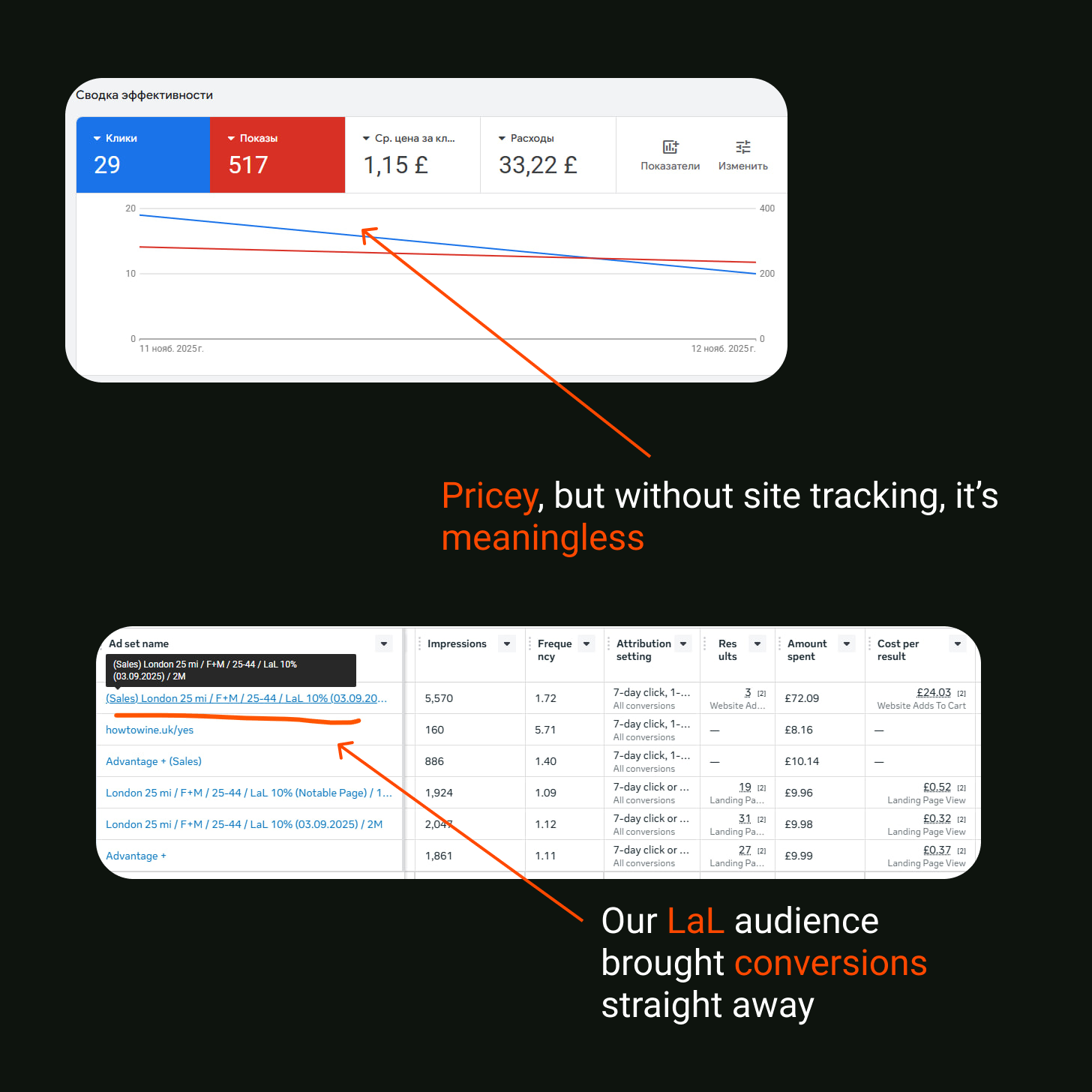
The first launch used the Traffic objective (optimised for clicks/visits). The task was to bring people to the site and test creative reactions. We ran Advantage+ (Meta’s automated targeting mode) and an older 10% lookalike based on followers. Numbers were steady, but they didn’t show who could buy an £80–£90 ticket. That was fine. The goal was testing reaction, not measuring purchases.
The second run used the Sales objective (optimised for purchases). We took a 10% lookalike based on How To Wine followers (September build) and let the system optimise for sales. On a test budget of about £72, we recorded three sales. With high probability, it was the full path: ad → site → button → payment. For a test, this signals the audience–creative–site combination works even without perfect tracking.
The difference between audiences showed up fast. Advantage+ brought traffic that was weaker in meaningful actions. The lookalike produced more clicks that looked intentional. The project gained a foundation. We got a group of people to test creatives, sequences, and behaviour on.
In parallel, the How To Wine account itself grew. For the November event, we got 49 new followers, and nobody unfollowed. This allows rebuilding lookalikes roughly once a month, or after each +100 followers. Each update makes the segment more precise. Retargeting grows at the same time. Eventually this creates a critical mass effect: sales become easier because the system has inertia and the audience is denser.
This stable traffic flow pushed the next task forward: fix analytics and the site. I prepared a spec for the How To Wine page, using the project PDF deck and pinned posts. I built a linear page structure as a test zone for Google Ads (Google’s PPC platform). Through it we can test keywords, scroll depth (25/50/75/90/100%), action sequences, and drop-off points.
Google Ads is running as a separate slow line. The first run gave basic clicks, and we avoided conclusions. Without keyword research, GTM (Google Tag Manager), and event tracking, the signal stays limited. Future Google tests will run between events, so by the time we sell, we already understand behaviour from two systems: Meta and Google.
This result appears with founders who accept marathon mode. They accumulate audience gradually, give ad systems time to learn, and keep pauses between cycles. In that rhythm, traffic homeostasis becomes possible: stable lookalikes, understandable analytics, predictable sales.
Result you can apply: Marathon rhythm compounds. Stable seed, repeated cycles, and pauses for learning give you controllable traffic, cleaner analytics, and more predictable purchases.