

Sydney Sweeney and “Flight”
Sydney Sweeney and “Flight”
When someone writes, “Wait, why have we even normalised seeing clothes only on perfectly built, Photoshopped people?” — that question usually hides a more basic blind spot: what a brand actually sells. It hits hardest in B2C, in brutal categories, in mass segments where product utility stopped being unique years ago.
In practice, nobody sells clothes.
If you’re building an apparel brand and planning to lean on “the clothes” as the main idea, growth will feel like pushing a boulder uphill.
The people who survive the startup meat grinder sell a brand. The brand sells a value stance. A positioning.
Positioning is a story about who you want to become.
Values are the things you’re willing to follow. Following always points forward — into a desired identity.
Ask yourself: a person looking at American Eagle’s Sydney Sweeney campaign — do they want jeans?
Or do they want access to something that looks slimmer, lighter, sexier, more “current” in the eyes of whoever’s approval they’re chasing (or in their own eyes)?
Are they buying fabric? Or a route?
In segments like denim, outerwear, basics, lingerie — where the functional task (cover, warm up, support) can be solved by almost any brand — the decision gets anchored in two jobs-to-be-done (JTBD):
— personal job: how you want to feel
— emotional job: who you want to look like (to someone else, or to yourself)
That’s why the fight isn’t about the purchase itself. It’s about the picture of the future you manage to draw.
Realism is secondary.
The real variable is desire — how badly someone wants to land inside that picture.
Here’s where the split happens:
- Sydney Sweeney × American Eagle (2025) — a promise of one future.

2. Calvin Klein (2023) — a different promise.
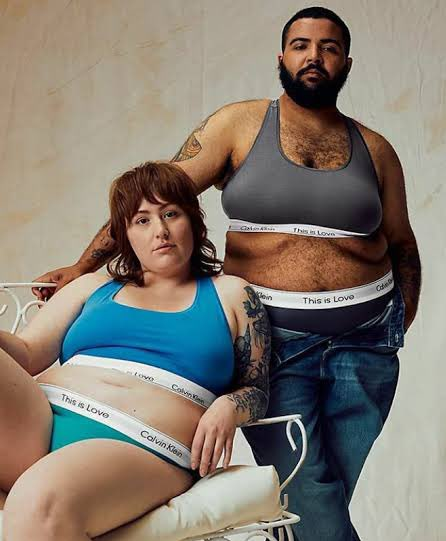
Both are legitimate.
Both pull in different directions.
A brand has to choose. The choice shows up in numbers: mentions, brand searches, wholesale demand signals, retail performance (if you run stores), e-commerce dynamics.
From there you get the real strategic question: commit to one promise and win that field — or test a second promise and watch the jump-cuts in demand.
Then comes the dangerous thought: why settle for X3 growth if the other promise can open a path to X10?
The cleanest answer is often the boring one: build a sub-brand that carries the second promise — so each identity stays coherent.
Oh. Hold on.
American Eagle already did that.
If Sydney Sweeney’s campaign looks like a fresh fork in the road, it’s actually a continuation of a much older move — at least as far back as 2006.
Meet Aerie.
A sub-brand born from a simple realisation: one audience won’t walk to two different “future selves” at the same time. One path leads to Instagram-perfect ideals. Another path leads to body positivity.
American Eagle kept its lane: denim, youth, freedom, sexuality, a touch of rebellion.
Aerie took the acceptance lane: real-body models, campaigns without retouching, the whole #AerieREAL aesthetic (copy-paste it and google that hashtag).
They basically said:
“We’ll stop mixing two identities in one bottle. We’ll make two bottles.”
Outcome:
— Aerie has repeatedly outperformed the mainline brand in key periods, and it grew into a major business inside the group.
— Aerie grabbed its audience and sold them a route into a chosen identity.
— It did it in mass market retail, where every purchase is a vote for “future-self A” or “future-self B”.
And yes — the “this is outrageous” cycle keeps repeating. People keep being surprised that identity can be more than one thing.
Meanwhile, market commentators noted that the Sydney Sweeney campaign added roughly $200M to American Eagle’s market cap overnight — riding a very warm updraft.