
RPA Marketing Case Study: 8 Months of Testing, Then Back to the Right Strategy
About the project “Russian software vendor, RPA technology”: promoting an RPA software-robot platform
Due to an NDA (non-disclosure agreement) and approvals for publishing this case, we had to blur and slightly modify some screenshots, and replace the real name with the one agreed with the company.
“Over 8 months, or 1,620 person-hours (almost a full year of one specialist’s full-time work, even though we worked as a team), we went through a long road of hypotheses and research. In the end, we returned to the strategy we voiced in the very first Commercial Proposal (a formal sales proposal document). For us, it confirmed that our competencies were already on point back in late 2023 and early 2024.”
“Russian software vendor, RPA technology” is a cloud platform and marketplace of software robots that helps businesses automate routine processes without coding. Users can choose ready-made solutions for different functions or build their own digital assistants using a visual builder inside the Vendor’s platform. The platform offers flexible pricing, training, and support, which makes adoption faster and more cost-effective for business teams.
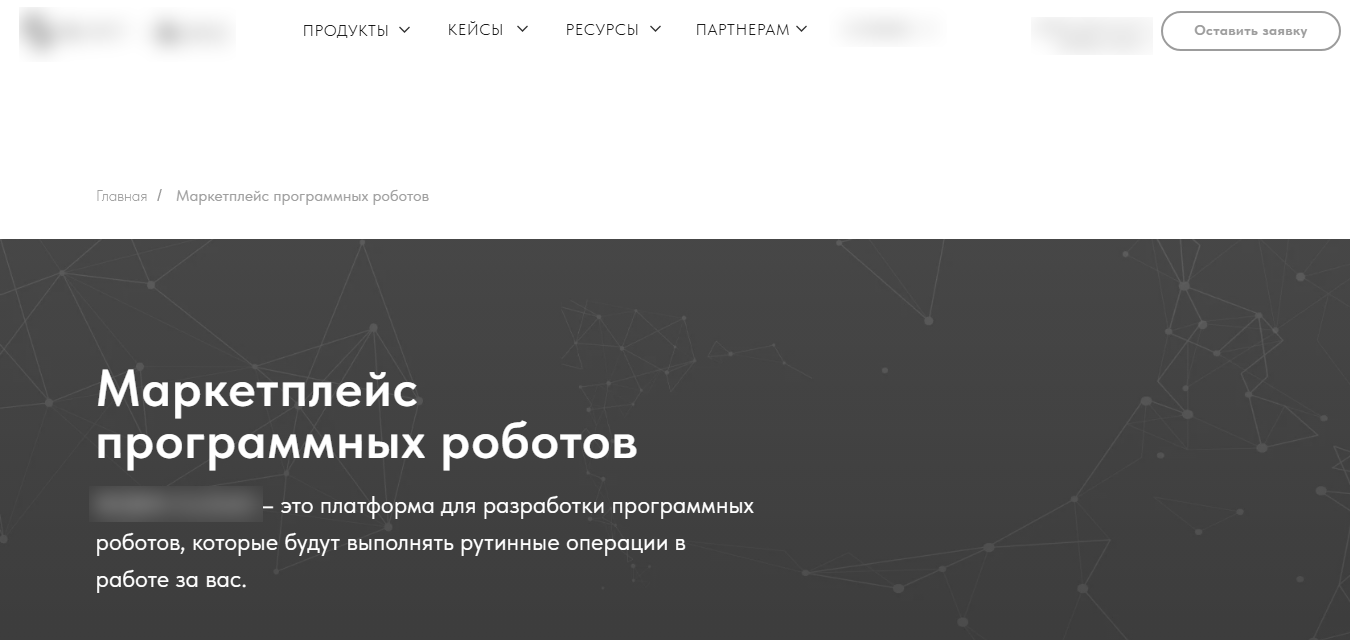
Client goals: increase sales and traffic to the RPA solutions marketplace
Increase sales through traffic: bring people in so they buy and sell software robots on a marketplace for software robots.
What we proposed at the start: promoting the “Russian software vendor, RPA technology” through community
- Telegram — as the primary platform for communicating with a B2B audience.
- VK (major Russian social network) — as an auxiliary or parallel channel for content duplication and community.
- TenChat (Russian business social network) — organic presence with no paid traffic, relying on the platform’s algorithms (as an add-on to Telegram/VK).
Traffic channels: where we drove the audience to the Vendor
- VK → Telegram
- VK → VK
- VK → Telegram and VK
- Yandex Direct (Yandex Ads, Russia’s main search ads platform) → Telegram
- VK + Yandex Direct → Telegram and VK
- Telegram (Telega.in — Telegram ad marketplace) → Telegram, Website, Telegram bot
Communication strategy: community, content, progrev, and funnels
- The core loop: build community → progrev (warming the audience before action) → try the product → collect feedback → improve → grow the next wave of community.
- Using The Buyer’s Journey and Jobs To Be Done to map behaviour and decision stages.
- A gradual entry into the work: starting with one platform and one traffic channel, then expanding.
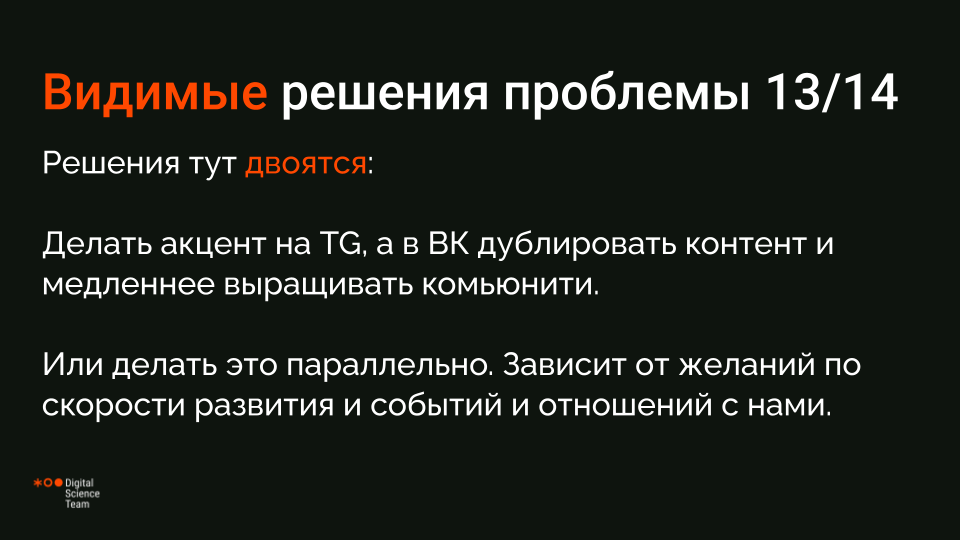
Where we landed: how we started, and how we adjusted the approach
In the end, we agreed to start with the simplest and most visible step: drive traffic from VK straight to the Vendor’s website. We skipped the community/progrev stages at first. It was a deliberate choice: test how the audience reacts to a direct entry, without a multi-step funnel.
At the same time, spoiler, we still worked in parallel on strategy elements — from positioning to creative messaging. Direct traffic still needs context and a clear framing.
The key difference versus the original proposal: we postponed building a community and sending traffic to Telegram or VK groups. We focused on a minimal hypothesis with a direct transition to the website.
Project flow: stages of implementing a marketing strategy for the RPA platform
Target audience analysis and CJM for the Vendor: first hypotheses
We started by working through The Buyer’s Journey, so we could understand which calls-to-action and which sequence of touches could engage decision-makers (ЛПР — Russian abbreviation for the people who sign off purchases) and help them grasp the product’s value. Back then, our “first weeks” process wasn’t as mature as it is today, yet we still gained clarity.
We saw a lack of value for the new audience the company chose. We also saw that decision-makers aren’t the whole target audience. They rarely rush to replace systems that already work. Change often comes through specialised teams, so our attention moved toward integrators.
To make the website conversion path tangible, we drafted a CJM.
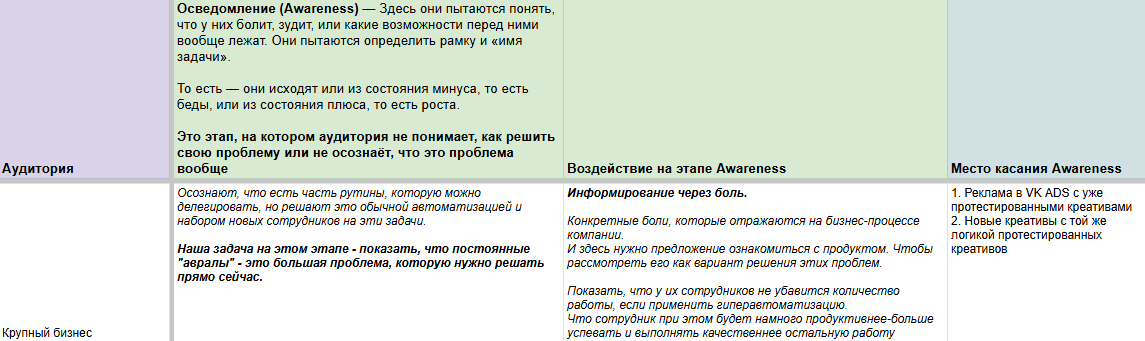
Because the product was “new as a phenomenon”, in the same class of novelty as neural networks were for many businesses, we faced a second task alongside selling: educating people about RPA.
Later it became clear that even outside Russia the category still feels young in practice, which means there is no “beaten path” for marketing it to mid-sized, almost-large, and small businesses.
In parallel with funnel prep, we ran early split-tests. We tested creatives on broad audiences.
We looked for approaches by professional direction: accounting, legal, IT. We said directly that it unloads employees from routine work and frees bandwidth for harder tasks. We also tested audiences interested in management, plus people around finance.
On settings, we went classic: retargeting to existing website visitors. The product isn’t universally known, yet the “automation” idea is significant and attractive. We also used keywords tied to professional tasks. For IT, that meant queries around programming languages (Python, Java) and frameworks they work with.
The main offer for these audiences: register for a webinar that introduces RPA and warms people toward buying the service. Early launches didn’t produce many registrations. Ads that invited people to the Telegram channel showed a high CTR.
Promoting RPA via webinars: the Step Logic case and the delivery format
This was late November. We needed to speed up to change something before the New Year holidays (a long seasonal slowdown period in Russia). We focused on webinars as a strong instrument for new solutions like RPA platforms. We had to package the webinar so it looked convenient and attractive on the Step Logic platform (the client’s webinar hosting platform). We rewrote the headline to a more value-focused one: “Unlock new possibilities with software robots.” We used the term “software robots” so people understand the acronym, and so the positioning doesn’t get confused with chatbots.
We also surfaced case studies with large companies: Bonduelle and HEINEKEN. We placed a clearer “what is this tech” explanation and a “how the zero-code robot builder works” block. We highlighted the Vendor’s advantages for smaller businesses versus alternatives. We also built checklists and instructions for diagnosing the need for robotisation, since we prefer a calmer, ethical marketing approach.
We suggested automated webinars too, so they could run more often and form a stronger conversion loop. That idea got implemented later.
During this period, we improved the cost of Telegram channel subscriptions: average CPF dropped from RUB 1,500 to RUB 1,100, and in some cases a subscription cost only RUB 518 (RUB — Russian rouble).
For the “IT for business” audience, we reduced bounce rate from 20% to 14.4%.
We identified successful creatives with the lowest bounce (15% bounces on site).
We also hit limitations. Some audiences were quiet, with almost no clicks. This was especially visible on segments built from CRM lists and integrator communities we expected to work.
Pulling people into Telegram channels remained hard: clicks were cheap, subscriptions stayed expensive.
To improve results, we kept developing and testing new creatives for large-business audiences based on fresh customer development data. They ran the interviews, and we used what was already collected.
We also launched Telegram retargeting to attract new subscribers.
Webinar acquisition and Telegram posevy: what worked
At that time, social acquisition campaigns weren’t the focus. We pushed webinar invites. Working bundles included interests like “mid-size and enterprise business”, “IT for business”, and we tested audiences built from webinar-related keywords. We experimented with creative angles and offers to hook different segments.
People clicked through to the platform, yet registrations were close to zero, even though we already knew those creatives could work. We were getting attention, then losing it before the target action. That led us to the idea of an automated funnel: people forgot about the webinar and about the Vendor, or never got truly interested. An auto-funnel gives value, keeps the thread alive, and shows where the decision breaks.
At that moment, nobody requested demo access. We also realised that webinar topics shouldn’t be chosen only by what the client personally wants to talk about. We needed a sharper focus: pick a segment and go deep. The hard part was segmentation, because the product fits many.
So we started from wider audiences connected to multiple segments, while still specific to businesses with a certain maturity and revenue. For very early-stage startups and small beginners, automation products like this rarely make sense in practice.
In parallel, we reached a point where it was time to go into niche Telegram channels via posevy (paid posts in third-party Telegram channels). Even through distributors, it’s expensive, and in this case cost wasn’t the blocker. We chose these audiences for the next wave of posevy:
System administrators
Development Operations (DevOps)
1C specialists (1C — popular Russian ERP/accounting platform)
Cybersecurity professionals
Plus a set of broader-profile channels.
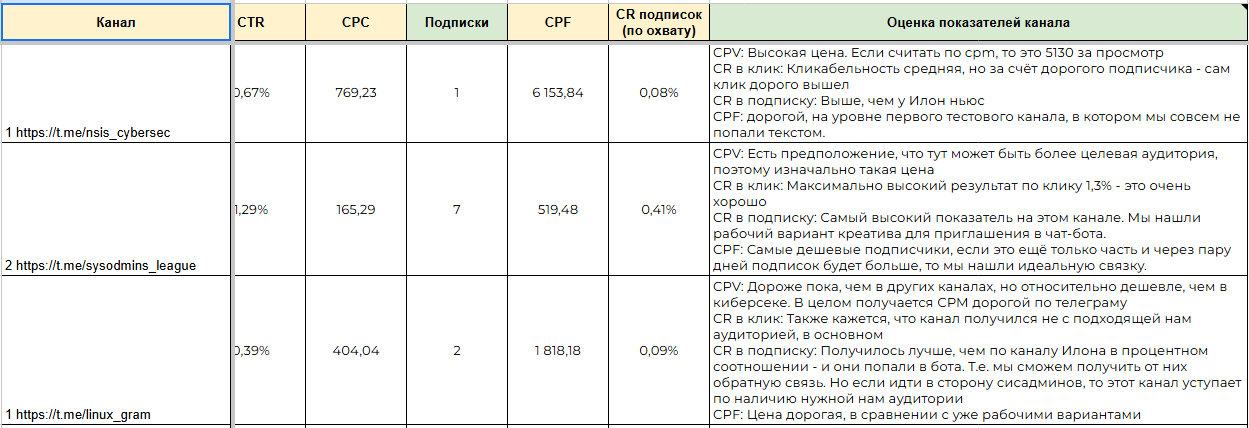
The biggest activity came from 1C channels, because we understood their pain points.
Posevy became a regular practice: on average, one post brought about 3,300 views, 34 clicks, and 16 subscriptions, with CPV around RUB 2.81 and CPC about RUB 507. It kept stable attention on the product, and it demanded significant manual coordination. The average CPF reached RUB 2,364, which became a signal: this tactic was eating focus and resources. We decided to keep posevy, and simultaneously search for more systematic ways to focus on the key growth hypotheses and optimise effort.
1C as an entry point: searching for the ideal audience for software robots
In the segment we targeted, reaching decision-makers directly is hard. We knew it from the start. At this stage, we crystallised a hierarchy of target audiences and a clearer view of how influence moves through them.
The logic was simple: selling to people who already optimise processes, manage operations, or work in product/operations leadership is easier. Cutting costs and improving efficiency is a familiar conversation. Explaining “what RPA even is” to a top signer is a heavier lift. Lower layers in the chain are often more willing to explore the mechanics: why it matters, how it removes pain.
And then 1C enters the stage. A large share of business processes in Russia depends on 1C products: from accounting to very specific internal systems. RPA can automate many of these, especially given the level of customisation in software robots. Ready-made solutions weren’t present on the platform at that time. The ability to build a robot for a specific request was real, and we sold the build capability itself while demand was forming.
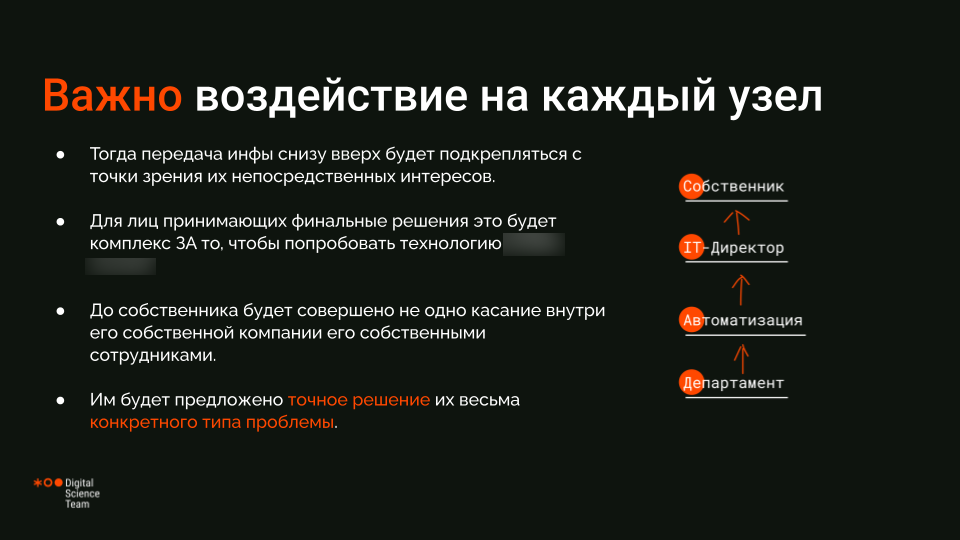
Each layer — a department, an automation team, IT directors, owners — needs its own story about how “Vendor RPA” solves their 1C-related issues. A department employee knows the pain of a specific configuration. The head of automation knows errors and complexity. The IT director tries to solve problems systematically, because their task is to optimise team resources. The owner sees the whole chain as expensive, and unavoidable.
If we sell 1C task automation through that chain, we increase the chance of selling other robots from the platform to the same owner later (cross-sale).
This kind of packaged sale also helps popularise the category. Few things beat a speaker at a business conference saying, “We boosted efficiency by 300% with software robots.” In this context, popularising the tech also popularises a specific brand, since Russia has very few platforms at this scale with comparable capabilities.
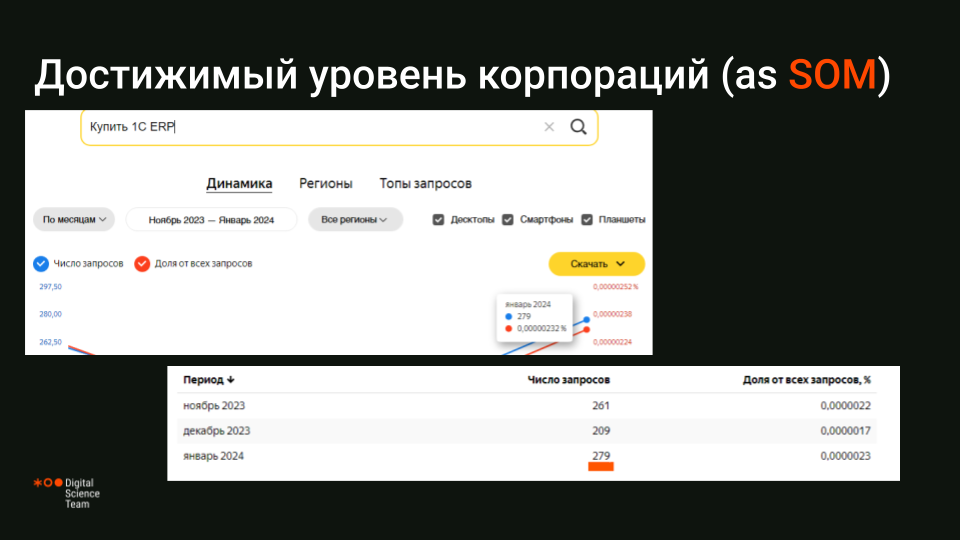
We still had to check reality. We estimated TAM (total addressable market), yet the data was shaky because we relied on Wordstat Yandex (Yandex keyword research tool) as an open source. We needed an insider view. Bogdan, the most experienced among us in this area, took customer development. Over the previous two years in IT, he worked with 1C user support. He also had sales experience at 1C-Rarus (a major 1C implementation partner) and with the cloud version of 1C.
To widen the view, we spoke with people with different levels of 1C experience and different roles: a teacher, an implementation/config expert, a developer, and a specialist with outsourcing experience.
Interviews clarified the state of 1C products: many recurring issues were being solved via “extensions”, which let teams keep vendor support without changing core configurations. That narrowed the obvious opportunity window for RPA. We also considered interviews with end users, plus the layer between users and developers: tech support. They have recurring issues they solve manually. Some of those could potentially be handled through RPA.
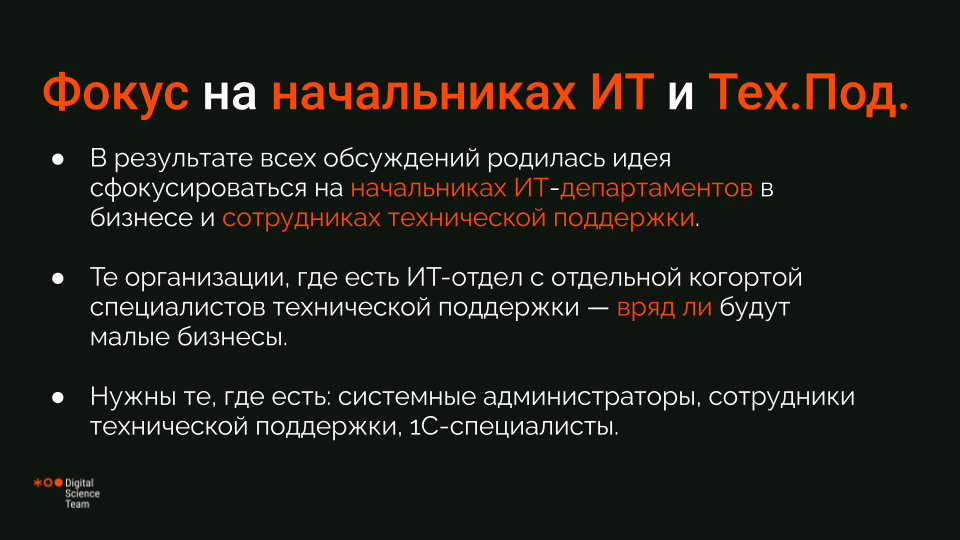
So we can’t sell directly to end users, since they don’t decide. Developers aren’t our natural buyers either. Who remains? Heads of IT departments and technical support teams.
1C became a marker of business size. If a company runs 1C at scale, it often has an automation function that could be interested in RPA.
A practical use of this idea: keywords in VK Ads and Yandex Direct.
Alongside the market reassessment, we leaned into education: explain what software robots are and how this differs from other automation approaches. Selling ready-made solutions isn’t always available early. Selling the technology and building the brand is what can carry the project forward.
We also discussed prototypes of ready solutions for internal tech support audiences: from migrating old PST files in MS Outlook to simplifying error reporting via ticket capture and systematisation. Once enough ticket data accumulates, a software robot can act like an interactive instruction layer for simple requests. It helps users get answers, and it saves the support team from wasting time on repetitive questions. It also avoids the classic “here’s a FAQ, good luck” move that users hate.
The audience segments stayed similar. The client expressed doubts about tech support as an audience, since it sounded unlikely that a support agent would build a robot “for themselves.” We pointed out a simple reality: motivation can break even in the most attractive segments. Our job is to build interest and explain what the product solves. We don’t control a person’s internal motivation. No business owner can “inspire” a need into existence if it wasn’t there before.
So our promotion always leans on people who already feel a need, and we educate people who have the problem yet don’t see the solution. We built JTBD. For our team at the time, it was a newer working framework. It helped us describe the circumstances where the target roles would consider RPA in business. The audiences stayed similar, and our focus tightened around IT directors and tech support agents.
At this stage, we added a third person to the project because time pressure grew. We needed support on marketing and bots. We kept searching for a workable way to promote the technology while meeting client expectations, and we kept splitting resources across several tasks.
With a larger team, we had bandwidth to study experience from outside Russia.
Borrowing experience: how we studied the global RPA market and extracted insights
We searched for cases and perspectives from people who market RPA products and build them. Here are a few of the most impactful sources that helped us quickly get oriented.
A short detour into tech again:
Robotic Process Automation (RPA) is a technology that uses software robots to perform repetitive, routine tasks in business processes. Since its emergence in the early 2000s, RPA has changed how companies approach automation. In recent years, the growth of AI has made the business potential of RPA more tangible.
One of the major benefits of RPA adoption is higher efficiency and better “service quality” for employees. Robotised solutions can free teams from monotonous tasks, which lets people focus on harder and more creative work. It also increases speed and accuracy, which improves customer service outcomes as a downstream effect.
7 Uses of Robotic Process Automation (RPA)
That last idea is what we needed to communicate in webinars and on the site. When you sell “technology”, it’s easy to forget why it exists. Our goal was to simplify life for clients and stabilise operations, not scare employees.
We found the same idea, framed in a more approachable way, in another article. A Closer Look at Robotic Process Automation in Customer Support
“However, while RPA offers many advantages, it requires a balance between automation and human involvement. While bots can efficiently handle repetitive tasks, they may lack the empathy, intuition, and problem-solving skills of human agents. An optimal approach integrates RPA with human agents, creating a symbiotic relationship where automation complements human capability.”
After understanding how RPA is described as a product, we looked at how it’s marketed and sold.
We found a short, simple algorithm we wanted to adopt as a “path” for implementing RPA in companies. Business people love clear sequences for efficiency improvements, and the expected outcome is profit growth.
1. Identify processes that need automation.
2. Choose a tool (inside the Vendor’s RPA platform in our case).
3. Implement automation.
4. Improve and scale automation.
(The same algorithm was described in How can you use RPA to automate customer service and support? It’s written for customer support, yet the structure applies broadly.)
Then we explored how IT teams approach software robots in real work. We read a range of articles. They were mostly persuasive narratives: “here’s why RPA will help.” One article had post-implementation numbers, and the tone still felt like “sell the idea.” We realised we couldn’t truly “borrow experience” from this set, because practical maturity wasn’t there in the sources we reviewed at the time.
Here’s the list of articles that shaped that conclusion. They have since been updated, and in May 2024 the picture felt slightly different.
1. What is Workload Automation? 5 Reasons to Adopt It in ’25
2. Top 10 Use Cases of Service Level Agreement Automation [’25]
3. 5 Ways RPA Can Modernize the IT Industry
Based on these, we assumed IT could become a bridge to businesses that want automation. The sources above mentioned e-commerce, paid healthcare, and customer support departments too.
The audience stayed the same, and the role shifted.
They became “conductors”. We started developing a hypothesis around active professionals and explored targeting audiences of IT conferences.
Our conference logic was simple: conservative people rarely invest into deeper learning and actively seek new information. We started from IT conferences, since they include proactive specialists who can lobby internal changes in their companies, even without being directors. After more brainstorming, business conferences became a match too, because they are built around efficiency and profit. RPA sits inside that promise.
We selected upcoming conferences in both categories and targeted their audiences with ads. We couldn’t win enough attention. The cost of “pulling” specialists away was too high, and registrations stayed at zero. Cost per visit from conference audiences was RUB 16.45. Average bounce was 45.38%, compared to targeting interests and keywords with a visit cost of RUB 10.77 and bounce at 45.93%. When you’re waiting for registrations, you choose the most efficient option. With no real difference, we returned to the simplest strategy.
Behaviour analysis via analytics showed we needed to redesign the landing page.
Landing redesign for the Vendor: improving structure and conversion
After discussing with our designer friend Varvara, we listed the key changes:
- Add proof-like data that can convince people: infographics from the presentation. Audience behaviour confirmed the need. About 40% of users tried to find more company/product facts by clicking toward the main page.
- Repeat the lead magnet in several places, so people don’t miss the value and the “gifts” for webinar participants, which helps with motivation.
- Edit form buttons for better readability.
- Make the page shorter by packing information under toggle headings (accordion blocks). It reduces visual weight and shows people only what they care about. It also fits fast decision-makers who want to skip “extra” context. People who need depth still have a way to go deeper.
- Swap the “What we’ll discuss” block with “Our clients”. It grabs attention faster, since the client logos are widely known and large brands.
Auto-webinars and warming automation funnels: how we tested RPA funnels
Now to the closing part. We mentioned bots earlier, and we didn’t spotlight them enough. We worked with an auto-funnel from the start, because we needed to keep attention and remind everyone who registered about the webinar. From our experience and market patterns, landing-page sign-up rates in the infobiz (RU term for the online course/info-product market) niche can be around 20%. Here it can be lower due to the product and the audience.
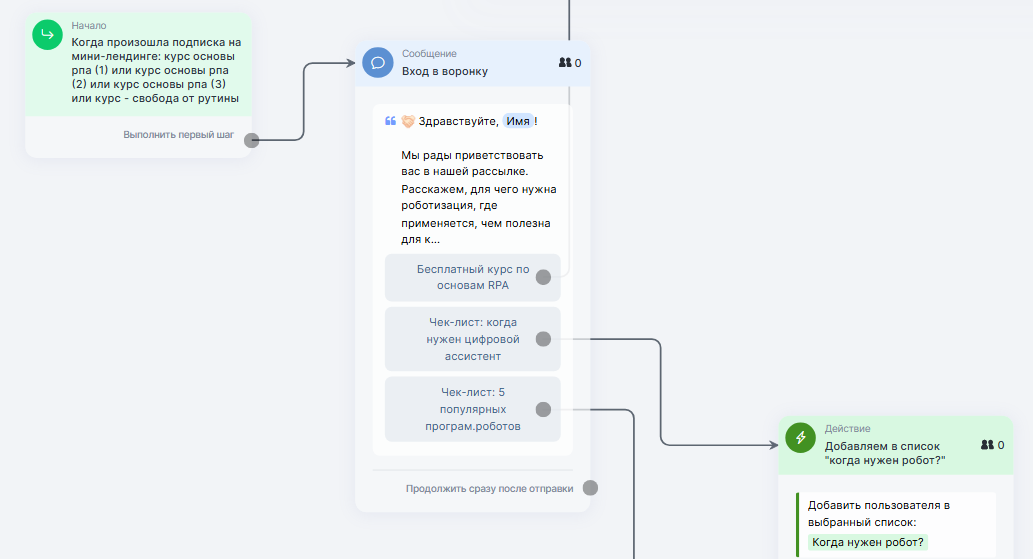
Initially, chatbots were built to deliver lead magnets. We needed a convenient way to pull audiences in, and lead magnets became the entry instrument. The bots did that job: they gave useful content that acted as a “first step” into the sales process.
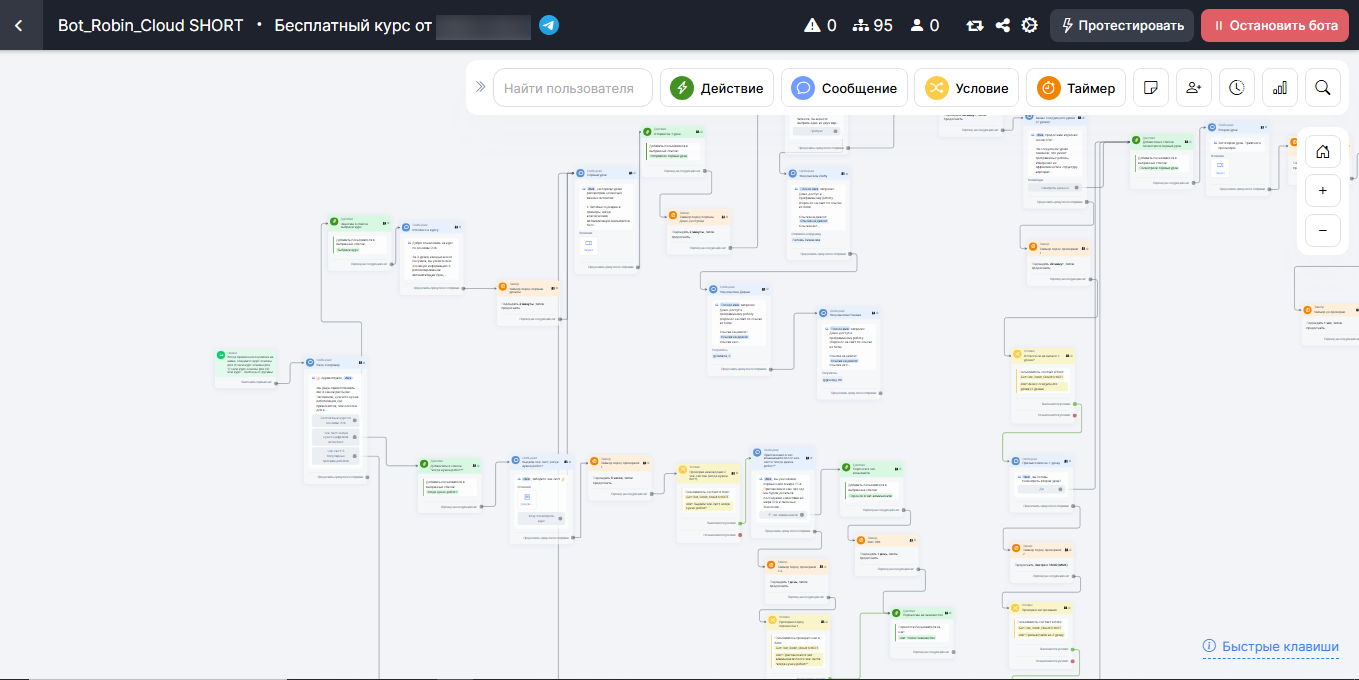
Later, we saw a way to use lead magnets more effectively by moving users into deeper engagement. At one point, we tried replacing classic lead magnets (checklists) with webinars hosted on Stepik (a popular Russian online course platform). We noticed a drop-off when users moved from the bot to the webinar. To reduce this, we extracted the videos from Stepik and integrated them straight into the bot. Video content became available inside the bot, structured over time.
This approach evolved further. We saw that users who consumed video were warmer and more open to continued interaction. So we returned lead magnets to the start of the bot experience, then guided users toward webinars. The funnel’s job was to warm the audience and explain product value. One persistent challenge stayed: framing the idea in a way that makes sense to people who don’t yet see why they need such a tool.
At this stage, we realised we needed simpler lead magnets. For example, we considered using tests that reveal pains and tasks. One idea was a test about professional burnout or the need to optimise workflows. After the test, users would get a tailored “here’s your problem → here’s a bot-driven path” solution, with examples of saved time and resources. Part of the team leaned toward other approaches, and we didn’t fully implement this strategy.
Another key issue was low engagement from IT people. Over-polished funnels triggered distrust. IT audiences are targeted by everyone, and they are often treated as the “top desired segment” due to income. In some cases, simpler funnels worked better. We needed a balance between real value and a straightforward delivery.
We began with checklists. They underperformed. We simplified the path and focused on bringing people into a Telegram channel, which worked better. At one point, the main task was growing subscribers for announcing the Vendor.
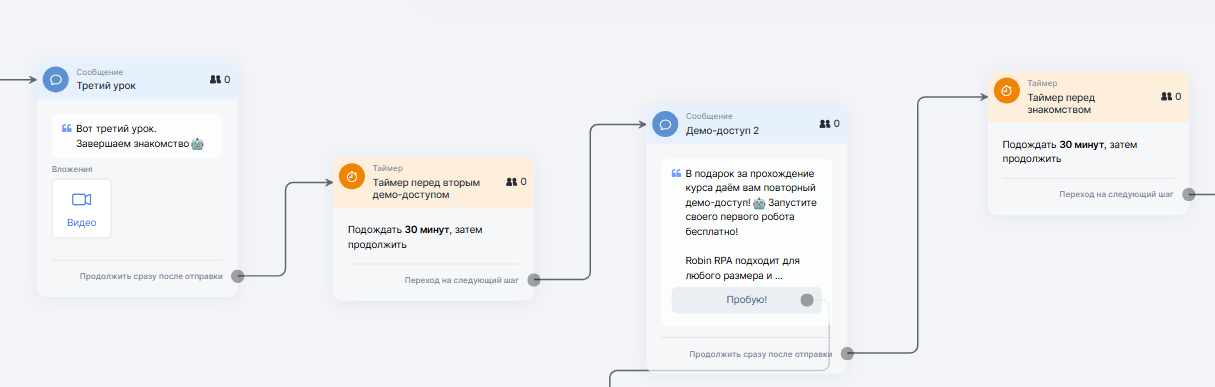
Closer to the end, as we moved to auto-webinars, we faced a need to shorten the bot. Why? A stable share of users got stuck around the middle of the lesson flow. Lessons of 5–6 minutes feel “optimal” on paper, yet this audience didn’t treat them that way. Four days of video was the maximum time window they were willing to give. Two months of running traffic to that funnel proved it. We noticed the pattern early, and we wanted to confirm it wasn’t just sample noise.
After trying different channels and audiences, shortening the path became obvious. We merged the videos into larger blocks of 20–30 minutes. It produced 4 messages, one per day, and we drove traffic to that auto-funnel.
We didn’t see immediate results. So we also prepared a separate validation of the auto-webinar strategy. Without several iterations, we would have no solid data. We negotiated three launches, so three webinars.
| Iteration | Date | Main action | What we did | Results | Metrics |
| 1 | 2024-06-10 | First auto-webinar launch | Launched the first funnel; evaluated attention and behaviour | Weak warming, cold traffic, low engagement | Heatmaps didn’t show stable attention; few interactions |
| 2 | 2024-06-17 | Second launch with a new landing | Landing structure changed, bot updated, messages revised | More clicks on key elements, still no conversions | Engagement around 10%, CTA clicks ~3% |
| 3 | 2024-07-02 | Testing new copy and the funnel | Tested delayed delivery script, added a timer and scroll tracking | Clicks on target buttons, engagement up to 15%, registrations still zero | Button CTR ≈ 4%, scroll depth up to 70%, average time on page ~1 minute |
Case finale: a strategic fork and a reset of client expectations
This was Chekhov’s gun (the storytelling principle about a gun on the wall) that had been hanging there for eight months. In the first Commercial Proposal we laid out a sequence: build understanding and trust before pushing sales for a product that requires both. Education, explanation, discussion — through community, content, and live dialogue. First, build the field of meaning. Then, move into adoption.
Back then, that strategy felt “too long” and “too indirect.”
Half a year passed. We tried a lot: direct traffic to the site, webinar tests, posevy, integrator hypotheses, auto-webinars, automation funnels. Step by step, we reached the same starting point: the need to build a space of trust around the technology. Cold traffic to a landing page won’t create that on its own. The conversation had to be about the essence of RPA and the values of automation, not about a feature list.
When the client reached this understanding, we decided to wrap up our joint work on the Vendor. We took it calmly. In the very first proposal, we described the strategy they came to after eight months. We also offered ourselves as the team to execute it. Their internal setup and processes made continuing in that format unrealistic.
No reproach. No regret. Just a story where the gun fired — at the moment when the scene had already changed.
Key takeaways from the RPA promotion case:
1. The early mistake: pushing sales before the market was ready
The client wanted immediate sales growth through traffic to the Vendor’s site, without building a base of trust and understanding.
The product was too new for the market to expect fast conversion. Think neural networks in 2021: many heard the term, few could explain where it fits.
Conclusion: an RPA platform needs value education and problem framing before it can convert at scale.
2. The initial strategy was correct: education → engagement → sales
In the first Commercial Proposal we suggested a funnel that matched the category:
- Community building in Telegram, VK, TenChat.
- Ongoing progrev through content and value-driven communication.
- The Buyer’s Journey and Jobs To Be Done to understand entry points and decision logic.
Conclusion: in an innovation category, the path through audience understanding is the practical foundation.
3. Early iteration gaps: underestimating the education layer
We tested direct traffic from VK to the site, and we got:
- Low registration conversion.
- High subscription costs (later improvements to RUB 1,100–518 came after strategy correction).
Even strong creatives couldn’t compensate for weak action motivation without warming.
4. Strategy adaptation: education via webinars and CJM
We started building touch chains:
- Webinars → explain RPA benefits → lead magnets → chatbots → website.
- Segmentation: accountants, lawyers, IT staff, managers.
Conclusion: new categories respond to a sequence of explanation, small pushes, and guided movement.
5. Turning toward IT as a bridge to business
Global sources (7 Uses of RPA, A Closer Look at RPA in Customer Support) reinforced one idea:
the core value of RPA is freeing people from routine and improving work quality, not a sterile “save money” pitch.
We saw IT specialists as a strong bridge to business: they understand the tech and can initiate change internally.
We also saw that the Russian IT market was still learning RPA, so ready-made playbooks were rare. We had to build the path ourselves.
6. Conference targeting tests: a lesson about the price of attention
We targeted IT and business conference audiences:
- Cost per visit: RUB 16.45, bounce: 45.38%.
- Interest targeting: RUB 10.77, bounce: 45.93%.
Conclusion: “stealing” attention through conferences was too expensive without a strong immediate offer.
Lesson: working through pain and interest warming is often cheaper than buying expensive direct attention.
7. Landing adaptation based on behavioural data
From click maps and scroll tracking:
- 40% of users searched for brand facts and proof → we strengthened credibility blocks.
- We built a compact structure with toggle blocks: lighter perception, targeted information delivery.
Conclusion: in innovation niches, trust grows from proof and easy-to-consume content.
8. Chatbots and automation funnels
The bot first guided users through lead magnets and landings, then through mini-lessons, then toward a webinar.
We faced issues:
- Users got stuck inside long scripts.
- Short lessons (5–6 minutes) still lost attention.
We reshaped the funnel:
- Merged lessons into 4 larger blocks of 20–30 minutes.
- Moved video into the bot to avoid external platform drop-off.
Conclusion: for cold audiences, even “short” education funnels often need to be shorter and simpler.
9. Auto-webinars: a promising hypothesis that opens slowly
Three auto-webinar iterations:
- First: weak warming, almost no engagement.
- Second: engagement grew to ~10%, CTA clicks ~3%.
- Third: button CTR ≈ 4%, scroll depth up to 70%, registrations still zero.
Conclusion: the system needs stronger warming before the webinar itself, not “more education inside the webinar.”
10. The main strategic conclusion
We reached the same core point we started from:
- Selling RPA requires a field of trust.
- People need clarity: why it matters, how it makes work lighter, which problems it removes.
The client reached the same conclusion after 8 months — and by then, the format of collaboration could no longer support a continued joint build.
The core lesson:
Education beats speed in niches where product value isn’t obvious at first contact. The age of the underlying technology doesn’t change the job. When a product feels innovative to the market, the first step is building a discussion crowd around it and growing that community. Sales paths emerge from there. “Faster sales” is a distant gravity point.
Summary table: actions → conclusions
| Stage | Action | Conclusion |
| Start | Direct traffic to the website | Low conversion without warming |
| Market learning | RPA research | Explain benefit for humans |
| Content work | Website revision, CJM | Proof and simplicity matter |
| Chatbots and automation funnels | Moving video into the bot | A shorter path improves engagement |
| Webinars and auto-webinars | Three iterations | Warming is required before selling |
| Strategic understanding | Final stage | Education matters more than speed |
Credits:
Fill in the lead form, or message Bogdan directly to discuss your project too.
Project team:
1. Zozulya Bogdan — agency lead, strategist, marketer.
2. Anastasia Kiseleva — project manager until May 2024.
3. Lyubov Simanova — traffic manager, until the end of the case (it ended in June 2025).
4. Polina Mladshikh — internet marketer since March 2024.
5. Daria Churilina — project manager from May 2024 to the end of the case.