
WordPress Built Faster Than Tilda
Year: 6, Month: 10, Week: 4, Day: 1
This Tale is about speed that became possible only recently: a WordPress site built in five days to ~90% readiness. A couple of years ago, that speed would have required a full dev team.
We needed a site in the legal/migration niche, built for growth, scaling, SEO, complex analytics, and a long life.
Tilda (Russian no-code site builder) didn’t fit this logic. It would give a fast start, then hit limits of its SaaS architecture. Most competitors in the niche used almost anything except Tilda. Tilda still appeared sometimes.
So we chose WordPress, even though the team has no full-time web developer. At the start, one is often optional. WordPress used to be adaptable without touching code as well. The question is how to build interactive mechanics without going deep into development.
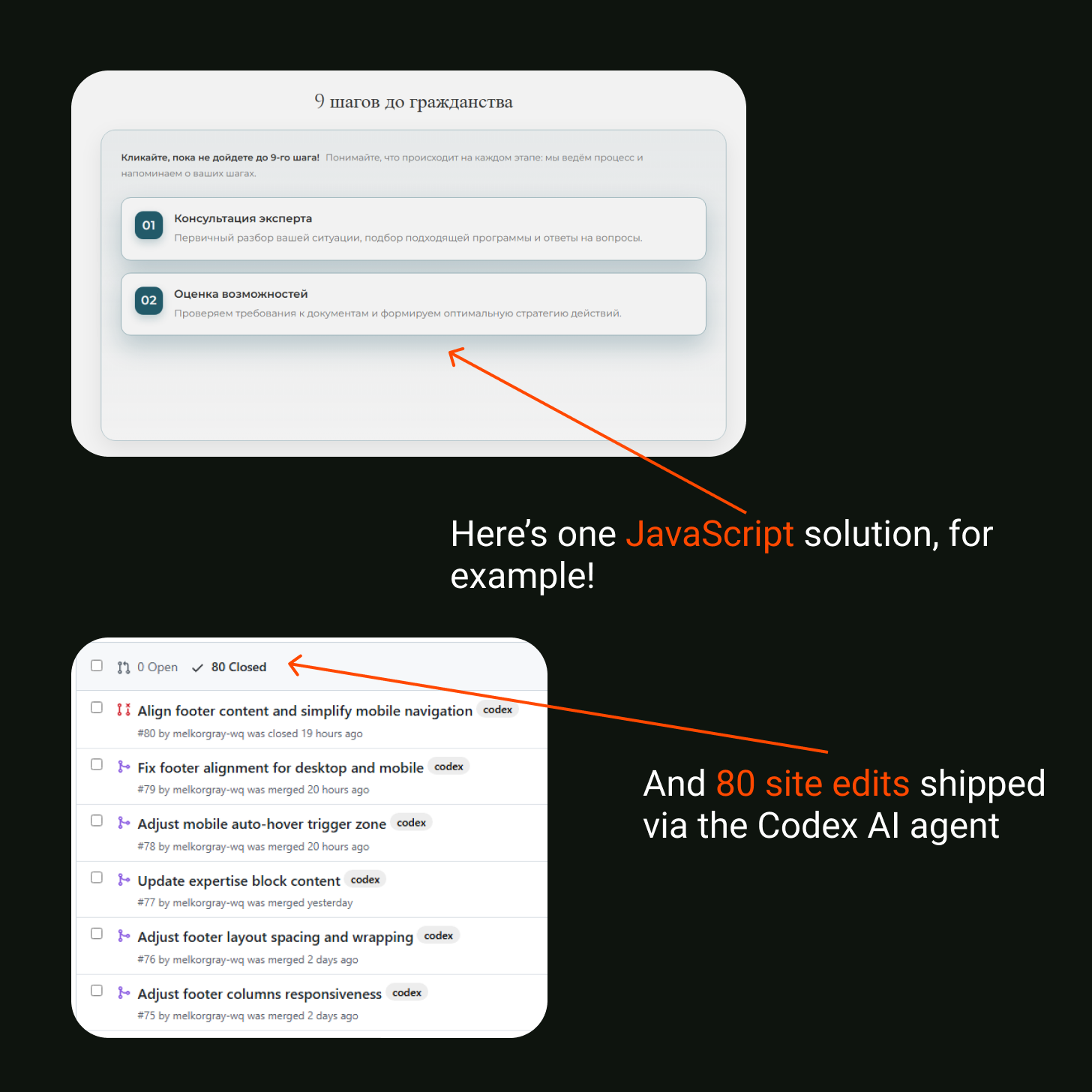
Example: on desktop we wanted a hover-based highlight animation. You move the mouse and a text block reacts, shifts slightly, changes colour. On mobile there is no mouse. We still wanted an accent mechanic that engages and warms a visitor — a potential lead.
The answer lives in JavaScript. Writing it from scratch would not fit a five-day sprint. So we changed the approach.
We started by selecting a ready theme from the official WordPress catalog. That reduced time spent on structure and provided standard animations. We installed it locally, deployed it on a laptop, and started reverse-engineering it by loading it into a GPT-5.2 thread (LLM chat model).
While hosting was being sorted, we connected the theme to a GitHub repository and added Codex (OpenAI’s coding agent). That made work iterative: we could quickly understand what lives where, what controls what, and reshape the theme safely toward project needs.
When hosting was ready, we moved the theme to the server. We used Git in “field engineering” mode: without perfect mastery of every internal mechanic (for example, why you should pull before merge still wasn’t fully clear), but with a working chain:
Write a spec for a block in GPT-5.2 → pass it into Codex → pull the implementation to local (a branch) → check if it’s OK → upload changed files to the live server via FTP. We haven’t even reached the step of connecting the live server to GitHub for one-command deploy via SSH.
In a few days we:
— rebuilt the hero section and slider logic so content changes are painless;
— adapted visuals for desktop and mobile without breaking structure;
— fixed the main expert profile card;
— ensured interactive blocks behave correctly on mobile;
— removed random unsystematic blocks;
— built the service roadmap into the page structure;
— brought contacts into a working state;
— added blocks that strengthen trust and expertise.
In five days we shipped a WordPress MVP at ~90% readiness for traffic. The remaining 10% is lead form, policies, footer tweaks, analytics events.
The result:
In five days the client received a business asset — a WordPress site built at a speed comparable to no-code, with growth potential that outlives it for years. The site can be rebuilt, deepened, scaled, adapted for any traffic and analytics scenario. It isn’t locked inside SaaS constraints. Open-source products give you freer rules of action.
There are projects where Tilda is a fit. This one wasn’t.
Nobody on the team is a professional web developer. There is general technical background, logic, carefulness, and the ability to learn while moving. PHP/CSS/HTML/JavaScript weren’t studied systematically here. The AI agent lowered the entry barrier, removed fear of code, and turned development into a manageable process.
Result you can apply: With tight scope and AI-assisted iteration, WordPress can ship at no-code speed while keeping long-term flexibility for SEO, analytics, and funnel mechanics.