
Digital Science Team to The Quiet Orbit: Naming & SEO
The naming Digital Science Team (DST) once plugged a clarity gap in a neat way: “digital science, team” — you instantly get what we do.
In practice, when I came up with that name, I moved a bit too fast and went straight for the obvious, so it would be unambiguously clear what we are, who we are, and why we exist.
Digital — digital marketing.
Science — the mindset and the method, the pedantry and the appetite for truth, even when a client expects simple agreement.
Team — that I’m not alone; that we’re a crew, an organisation-as-organism, a union.
Over time, two critical layers of risk surfaced. It got especially loud when I started building the website and thinking seriously about SEO.
1. Legal
“Digital Science” shows up in USPTO/EUIPO filings (USPTO: US trademark office; EUIPO: EU trademark office) as a publishing company, a SaaS platform, and a design studio.
The DST acronym is already taken by IT consultants in Europe and logistics companies in Asia.
So, in every new country, I’d have to prove distinctiveness or enter an expensive coexistence scenario.
Turns out there’s a legal practice for that: a trademark coexistence agreement (a formal deal that allows two similar names to operate side by side in specific classes/markets).
2. SEO / branded traffic
Someone else’s Knowledge Graph card:
In the right-hand column of Google, there’s already a scientific publisher called Digital Science: logo, wiki facts, links to Nature articles. The algorithm pulls data from Wikidata and high-authority domains with DR 90+ (Domain Rating by Ahrefs; 0–100, 90+ is extremely authoritative). To “take over” that card, I’d have to rewrite Wikidata, accumulate hundreds of academic references, and outgrow someone else’s trust signals — over years, and over thousands of dollars.
Competitors with strong domains:
digital-science.com (DR 78) and digitalscience.agency (DR 52) already rank top-20 across “digital + science + agency” clusters. With profiles like that, branded SEO was heading towards recurring spend: CPA goes up, ROMI goes down.
The path to a new name
First: yes — I used AI. Specifically, I kept pushing ChatGPT 4o. It took about a week, and it would’ve taken months if I hadn’t done something important beforehand for brand consistency.
I built the mission, values, and philosophy, and I thought through the symbol system. The key became an homage-slogan.
That’s why, in the end, re-naming felt closer to swapping a skin than rebuilding a character from scratch.
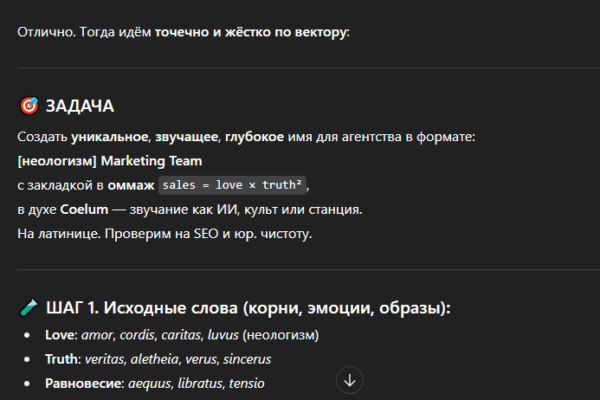
- I locked into the prompt the importance of leaning on the homage-slogan sales = love × truth², because that form was earned the hard way, over time. It’s a language for “our people”. It’s a meaningful part of differentiation and the value proposition — positioning.
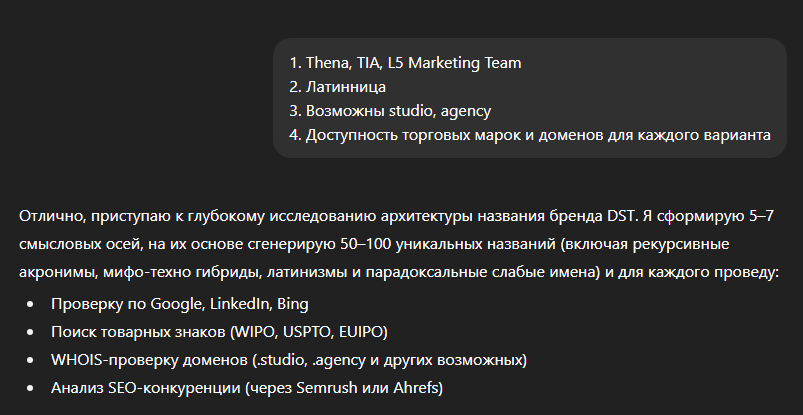
- We generated 100+ candidates (three waves, 107 names total: ~40 formulas/Latinisms/neologisms → +35 myth/cosmos/Mass Effect/Star Trek → +30 semiotics), and each one was checked by ChatGPT through filters:
Google/LinkedIn — any live clones?
WIPO/USPTO/EUIPO — any ™ minefields? (WIPO: World Intellectual Property Organization; global IP/trademark search portals)
WHOIS — a free spaceport, low radio noise?
If anything looked “interesting” but was already taken in marketing/advertising, the name went straight to the bin.
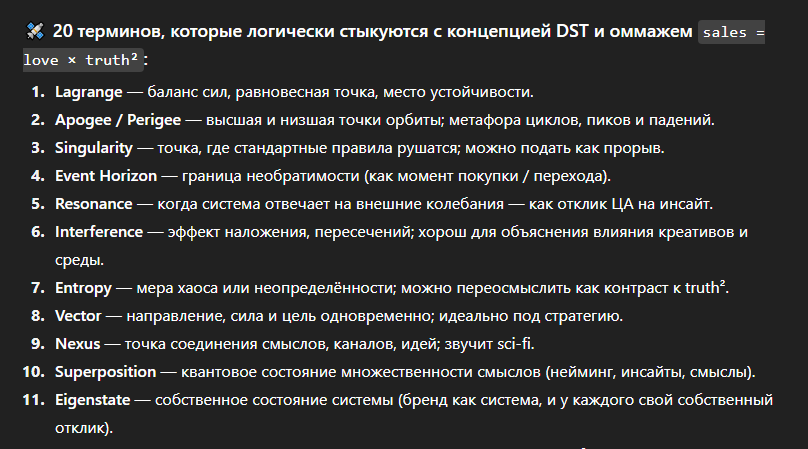
Generating options wasn’t that hard — you give GPT a direction, it generates.
The hard part was thinking through why each option doesn’t fit, and where exactly it fails.
The interim top list looked like this: Thena, TIA, L5 Marketing Team, Signal and Form, Light Protocol, Assembly of Clarity — all of them felt alive until checks showed trademark collisions or a noisy SERP (search engine results page).
AND THEN IT CLICKED!!!
I didn’t need a brand-new name. I needed the old name, phrased differently.
So I nudged the model towards semantic and semiotic synonyms, first for individual words:
Digital, Science, Team
Here are semantic synonyms for Digital:
digital, cyber, online
Here are semiotic synonyms for Digital:
pixel, signal, bit
Here are semantic synonyms for Science:
research, knowledge, empiricism
Here are semiotic synonyms for Science:
formula, flask, atom
Here are semantic synonyms for Team:
crew, collective, alliance
Here are semiotic synonyms for Team:
high-five, huddle (a tight team pile), chevron formation
Once I saw where the wind was going, I realised the solution lived in semiotic territory.
Then I asked for 10 semiotic synonyms for the full name Digital Science Team. And it worked. Semiotics became the filter: the name turned into a sign of how we work — a quiet pull, not a literal label.
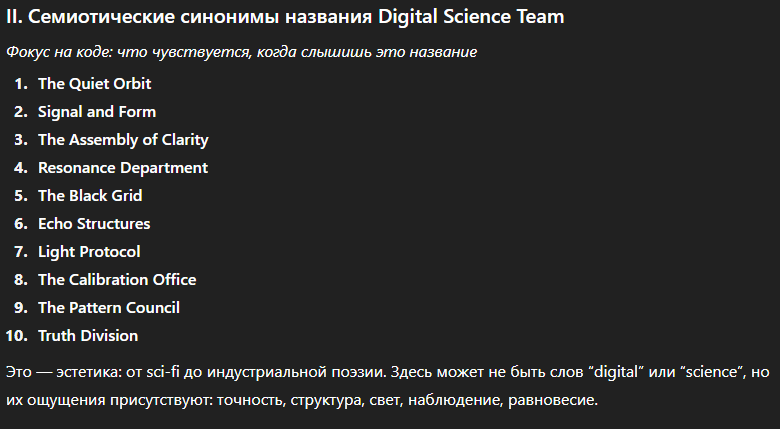
3. The final two were The Black Grid and The Quiet Orbit.
• The Black Grid looked available on the surface, but a deeper scan found: a US design studio with the same name (™ conflict), an occupied Knowledge Graph card, and a .com with DR 55+ (DR 55+ is Domain Rating from Ahrefs. It signals a strong backlink network and high authority in search engines’ eyes. Competing for branded traffic in that situation, or trying to take over the Knowledge Graph card, would be expensive and slow).
• The Quiet Orbit came out clean: zero trademarks, quiet-orbit.com / .agency available (domain extensions), and a quiet SERP (Search Engine Results Page — the results screen you see after typing a query into Google, Yandex, or any other search engine).
I kept it — it matches the “quiet gravity” concept and slots into place without rewriting the symbolic system.
What’s next
I haven’t filed for the trademark yet. The priority was registering the website and staking the name, so anyone checking it later via WHOIS will see it’s already occupied, and so I can start building informational mass under this name. I kept the spirit of DST, and I moved it into an orbit with less noise.
Now it’s mostly operational work: change the Telegram channel handle (Telegram: a popular messaging app with channels; already done), tweak descriptions and bios, and so on. I named the ship with my sleeves rolled up, and I’m betting I’ll sail under this name for a long time.
And then — grooming all the profiles and accounts: across social networks, updating pinned posts, rebuilding highlights, the usual…
Epilogue and useful takeaways
— AI can’t hold all the context needed to solve this kind of problem “by itself”
— You still have to build the full context and depth of your brand
— With AI, thinking becomes faster, which compresses timelines. A two-month naming battle collapsed into one week of active brainstorming and verification. Without that acceleration, my website timeline would have drifted from ~8 months towards ~10 months to production — close to a year.