

How to work with the “square” of target audience measurement
This is a dry HOWTO instruction on how to work with the “square” of target audience (TA) measurement — and why it’s even a “square”.
Essentially, this is a published slide deck: slides, broken into parts, plus a few explanatory comments about each slide.
Terms, and why they’re called that
- There is an “audience”.
- There is a “target audience”.
- And there is target-audience measurement.
What’s the difference?
- Target audience is a set of parameters and dimensions describing the people a business sees as consumers of its product. The business aims at them — both in its overall strategy and in specific products.
- Audience is what you ended up with after you did marketing and product work to reach that target audience. Or it’s simply a measurement “snapshot” of the current audience of the business and/or a specific product. And yes — it’s also described through dimensions.
What is “target-audience measurement”?
To understand the term “measurement”, let’s lean on the English word dimension.
Among the classic meanings (height/length/width), in English this word also means something else.
Dimension — a part of something:
- There are many dimensions [=aspects] to the problem.
- The social/political/religious dimensions of the problem must also be taken into account.
- The more powerful engine gives this car a (whole) new dimension. [=makes the car very different]
So what is “target-audience measurement”?
These are measurable — in numbers, and not only in numbers — aspects of the audience a business is aiming at in its overall strategy, or within a chosen product. What sub-groups it splits into, and by which aspects it differs.
What the TA Measurement SQUARE looks like
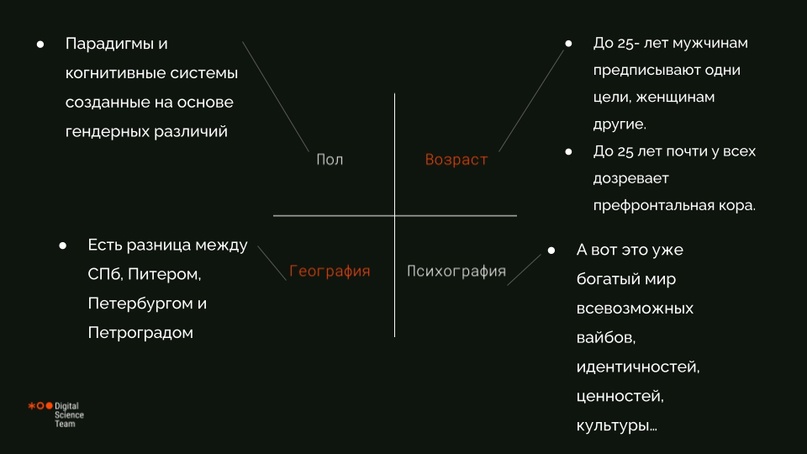
Back to terms — two key ones
- Cognitive system
- Paradigm
And how this affects TA measurement
“Cognitive system” is…
A cognitive system / cognitive structure (from Latin cognitio — “knowledge, representation, understanding”) is a system of knowing that forms in consciousness as personality develops through upbringing, education, observation, and reflection about the world. Based on this system, people set goals and make decisions about how to act in a given situation, trying to avoid cognitive dissonance. At the core of the cognitive system is the interaction of thinking, consciousness, memory, and language; the carrier of this system is the human brain. (Wikipedia; translated)
“Paradigm” is…
In science and philosophy, a paradigm (from Ancient Greek παράδειγμα — “pattern, example, model”) means a certain set of concepts or thinking templates, including theories, research methods, postulates, and standards according to which further constructions, generalisations, and experiments in a field are carried out. (Wikipedia; translated)
“Paradigm → Cognitive system”
- In society, there are certain social, political, economic, and cultural concepts, generalisations, postulates, and shared beliefs — in one word: paradigms.
- Based on them, both our professional formation and our personal upbringing are built — our cognitive systems.
Two rough examples:
Paradigm “a woman is the keeper of the home” → cognitive system training a person away from expansion/ambition → for some women, it will be harder to sell a career-growth product.
Paradigm “a man is the provider” → cognitive system training self-evaluation through achievements → for some men, it will be harder to sell products and services aimed at developing self-worth.
(For readers outside Russia: these examples are not “Russia-only”. They’re simply familiar, blunt cultural templates that exist — with variations — in many societies. The point is the mechanism: paradigm → cognitive habits → purchase resistance.)
“What does this have to do with TA measurement?”
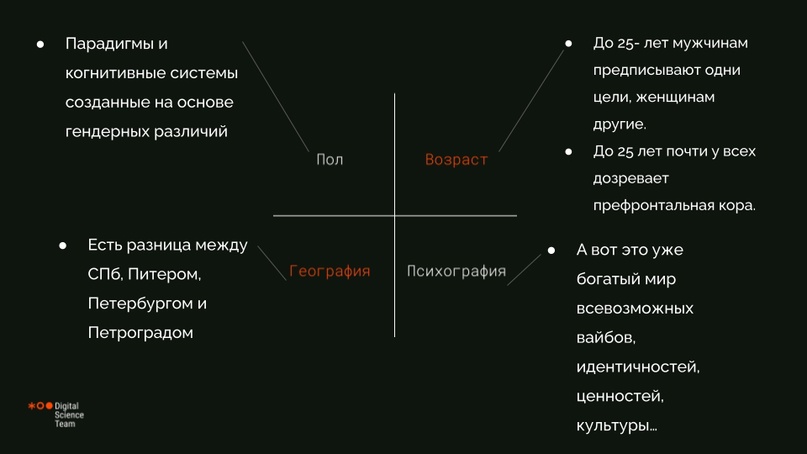
The measurement square is work with combinations of paradigms and cognitive systems.
Both socially conditioned ones and scientifically grounded ones.
What the TA Measurement Square looks like through these terms
“How and where do you get data for TA measurement?”
- Parsers;
- Hypotheses (educated guess);
- Research by social scientists;
- Data collection: hypotheses + traffic + analytics;
- A CRM system.
Disclaimer
In this material, it’s impossible to unpack every tool deeply. I can only describe them and how they can help. In the future, this block will be expanded into separate, more detailed lessons where we’ll break each method down properly.
Parsers:
A parser (English parser; from “parse” — analysis, decomposition) is a tool that “reads a website”.
- If something is displayed on a website, a parser can read it and systematise it.
- If something can be extracted from the visible code of a web page, a parser can read it and systematise it.
- If something can be requested via an application programming interface (API), you already understand what a parser can do.
Examples of parsers: Target Hunter, Cerebro, Popsters, Social Blade. (For readers outside Russia: Target Hunter and Cerebro are popular tools in the Russian-speaking marketing ecosystem, especially around VK/social analytics; Popsters and Social Blade are more globally recognised.)
Reasoned assumptions:
A hypothesis is not just a guess. It’s a reasoned guess.
“Reasoned” should not mean “I have an opinion”, or “this creative is boring” (yes, I’ve seen that).
A hypothesis can be formulated in at least seven ways, but at this stage — for this material — these two are enough:
- Systematised observations;
- Properties of the object.
The idea is: after you combine all methods of building the TA measurement square, you will still end up with a hypothesis — it will simply be better grounded.
Research by sociologists / social scientists:
- Active googling and reading research by sociologists and other social scientists;
- Studying surveys and spotting values and social norms inside them (paradigm shifts);
- Reading actual профильная literature — monographs and books on social or practical problems.
Data collection:
A classic test ad campaign:
- Formulate the offer;
- Put the offer into the ad copy and/or onto the website/community page;
- Pick visuals;
- Split-test creatives;
- Split-test audiences;
- Analyse what you got.
Analytics systems: Google Analytics, Yandex Metrica & etc. (For readers outside Russia: Yandex Metrica is a local analytics platform comparable in role to Google Analytics; it’s widely used in Russian-market projects.)
From CRM:
If you already have buyers, it’s a good idea to record them in a CRM.
And inside a CRM, you can create columns that map to your TA measurement square.
Then, once you accumulate enough entries, you can try to systematise them.
More precisely: all your clients should end up in your CRM one way or another — exactly so you can systematise real cases of people buying your product or service specifically from you.
A couple of measurement aspects…
… that are truly “measurements”, meaning numeric. There’s a certain danger here — and it’s worth avoiding it.
What obviously has a number in TA measurement:
- Age
What you can assign a number to in TA measurement:
- Number of clients
- Gender
- Geography
Important terms and aspects of numeric measurement
- Percent ratios.
- Regression to the mean.
- Averages: arithmetic mean, median, mode.
The obvious:
Let’s say you have 10 clients:
- 7 men;
- 3 women;
10 is 100% of clients. 7 is 70%, 3 is 30%. In percentages it looks neat. But the dataset is tiny — only 10 clients.
The threshold of reliable measurement:
Short version: the more, the better. The larger the dataset, the more it aligns with regression to the mean:
Regression to the mean (English: regression towards the mean) is a type of behavioural statistical misconception where measurements of a random variable taken before and after extreme values tend to move toward the average value of the whole sample. It is a serious obstacle for statistics: by “polluting” a sample of independent random variables, it shifts observed results and can lead to wrong forecasts. (Wikipedia; translated)
What is average tends to regress toward the average. What is exceptional stays exceptional.
How regression to the mean works:
Example: academic performance of students in a middle school class.
If each participant in an experiment is given a test with 100 questions, where answers can only be “yes” or “no”, it’s obvious that with a large mass of “average” results, there will be people who do extremely well and extremely poorly — simply by chance. If later (say, the next day) you give similar tests to the same students again, the distribution will somewhat narrow toward the average: those who randomly scored very high are unlikely to be that lucky again, while those who performed very poorly will likely learn something and improve. Of course, there will still be students with exceptional abilities who consistently score high — but then their results are no longer random variables, so the regression-to-the-mean effect doesn’t really apply to them. (Based on Wikipedia; translated)
THAT IS — with large numbers, randomness averages out.
And what is exceptional stays exceptional.
Averages:
There are several types. Let’s discuss the ones we need here:
- Arithmetic mean
- The median
- The mode
Arithmetic mean:
Computed plainly: (2 + 3 + 6 + 7) / 4 = 4.5
Benefits:
- Easy to compute and understand,
- Clear interpretation: if the average age of a group is 30, it means the group’s average age is 30.
- Practical as a quick summary number (but be careful with outliers).
Downsides:
- Sensitive to outliers:
If there are a few people with extremely high or low ages (for example, a child and an elderly person), the mean may become non-representative. If there are 10 people and 9 are 25 years old, while the 10th is a 5-year-old child, the mean becomes 22 — which doesn’t reflect the real age structure of the group. - Ignores distribution:
The arithmetic mean does not tell you how ages are distributed. In one group ages can be spread evenly; in another they can cluster in a narrow range. The mean alone won’t show that difference.
Median:
Computed like this:
Take 5, 10, 15, 20 — already sorted. The count is even, so the middle is two numbers: 10 and 15. To get the median for an even count, take those two middle numbers and compute their arithmetic mean: (10 + 15) / 2 = 12.5.
Median of 5, 10, 15, 20 is 12.5.
Now take 3, 6, 9, 12, 15 — also sorted. The count is odd, so the middle is 9. Here it’s simple: no need to compute a mean.
Median of 3, 6, 9, 12, 15 is 9.
Pros:
Resistant to outliers:
The median is not sensitive to extreme values, so it often gives a more stable estimate when outliers exist.
Useful for “non-normal” distributions:
The median works well when the data is uneven/chaotic, because it forces ordering and focuses on the centre.
Cons:
Doesn’t use all values:
The median focuses on the centre of the ordered sequence and can lose information about diversity inside the group.
May not give the full picture:
In some cases — especially when precise distribution matters — the median alone is not enough.
Mode:
Computed like this:
Take: 21, 25, 25, 26, 28, 28, 28, 30, 32, 35
21 appears 1 time, 25 appears 2 times, 26 appears 1 time, 28 appears 3 times, 30 appears 1 time, 32 appears 1 time, 35 appears 1 time.
28 appears most often (3 times), so the mode of this dataset is 28.
A dataset can have one mode (unimodal) or multiple modes (multimodal) if several values share the highest frequency.
Pros:
Mode is easy to compute: it’s the most frequent value(s) in the dataset.
Mode can be easier to interpret for target audience analysis: it shows the “most typical” or most common age in your sample.
Cons:
Mode does not provide full information about age diversity. It ignores most values and ignores extremes, which may be inaccurate for large and diverse samples.
If the sample is not representative or incomplete, the mode can be distorted.
When the target audience has significant age diversity, the mode may fail to reflect it.
So which one is “the correct” one?
Compute all three, and watch how they overlap, complement each other, intersect — or disagree.
How to get your own TA Measurement Square
- Take your product.
- Describe the TA measurement square for it using at least two methods: reasoned assumptions, research by social scientists, data from parsers, your own calculations using the three types of averages.