

How to Work with Positive and Negative Reviews
This article answers these questions:
– How do you work with positive and negative customer reviews?
– How do you use customer reviews to promote a company?
General notes:
Let’s first look at reviews through the lens of the customer journey, including customer experience (CX).
1. First, a potential customer feels they have a need: to fix a downside, or to realise an upside.
2. Either way, the person starts searching for solutions and comparing them.
3. After the purchase decision, the customer starts using the product or service.
4. And after that usage experience, there is finally material for a review.
Reviews can be negative or positive. Negative reviews are a way to express disappointment and help other people avoid making the same mistake.
And they’re much easier to get.
At least for two reasons:
1. That’s how our brains evolved.
Negative signals trigger stronger emotions and help us avoid wasting precious resources.
Knowing where there’s plenty of food and warm sunshine is great. Knowing where a snake can bite you and you’ll die quickly is more important.
2. When you sell a product, you create expectations — and there’s often a risk of selling more expectation than the product can actually deliver.
That mismatch can trigger a negative review.
Positive reviews are rarer.
Customers who are happy often just keep using the product. They don’t stop and think, “I should write a review.” The need is solved, and writing a review is extra effort on top of the work they already did: figuring out what they need, comparing options as they understand them, then going through the purchase and receiving the product.
All of that takes mental and decision-making resources.
Sure, there’s a business strategy where you create THAT kind of service — one that exceeds every positive expectation — and your hands almost itch to leave a review.
And there are entire strategies for extracting positive reviews:
From encouraging it with a discount, a gift, a bonus, all the way to the boring grind of reminders. Google, for example, uses gamification inside Google Maps. The moment you write a review, you get a message about how many people read it, and a prompt to leave more.
Yandex has a similar story too (Yandex Maps is a major Russian mapping/reviews platform).
There’s also a danger hidden in reviews, both negative and positive: they’re always particular categorical statements — particular-affirmative or particular-negative. Meaning: there is valuable information in a review, but it does not represent all users of the product.
That’s also one reason why overly praising reviews get discounted. People understand there are no perfect products, and “sterile-perfect” reviews sometimes repel more than reviews that are a 4.0 or a 4.5.
And then there are reviews you won’t hear at all — the infamous “sarafan” (literally “sundress” in Russian; idiom for word-of-mouth referrals).
So reviews help social proof the effectiveness of a business, but you always have to remember: it’s a narrow sample. People talk about a product when they feel it deserves mentioning — whether one-on-one, or in a circle of friends and acquaintances.
Even fewer people will write their thoughts on independent specialised platforms, and even fewer on the brand’s own platform.
That doesn’t make reviews useless information. Not at all. It just means reviews are “wind” — and you must correct for wind.
You can and should work with reviews in two ways:
1. Break down and analyse the reviews that already exist anywhere, in any form.
2. Design the review when you collect it for yourself.
How to analyse and break down reviews:
Properly speaking, this is called OSINT — Open Source Intelligence.
Meaning: any reviews you can find publicly.
1. On competitors’ websites.
2. On competitors’ social media.
3. On Yandex Maps (major Russian mapping/reviews platform), Google Maps, 2GIS (a Russian mapping and business directory service).
4. On specialised review aggregators.
5. On general forums or niche forums — and here it’s not strictly a “review” but a mention inside a discussion. You might see it, for example, in a thread on a social network that is officially restricted in Russia (for instance, some Meta platforms).
When you analyse an existing review, it’s important to find a “meaty” version — a myasnoy (literally “meaty”; detailed, specific review).
What a “non-meaty” review looks like, using a restaurant as an example:
“I went, loved it! Service and food were top class!” — plus it can still be a 5-star rating.
There’s nothing you can do with that.
A “meaty” review is when there’s concrete detail:
“I went to restaurant AAA on Vologodskaya Street (in case it’s a chain), ordered dish BBB, and I liked it — it had that sour note I expected! Looks like the chefs use recipe variant VVV. I sat there with my girlfriend GGG for a good while!”
Of course this is abstract. In real life not everyone writes like that — sometimes more specific, sometimes less.
But if there is ANY specificity, you can already work. Because as you accumulate enough analysed reviews, you get a bright, nuanced picture.
From the abstract example above you can conclude things like:
- You know the restaurant and a specific location, even if it’s a chain. Meaning: what happened in one branch can repeat — or not repeat — in another.
- This restaurant has dish BBB, and the recipe can vary. This customer liked the variant they got.
- It works for some couples; this couple sat there for GGG time.
Here’s a non-abstract example, taken from here.
“Bright, pleasant view and interior, lots of books, cold water freely available. Comfortable tables with hooks and tall chairs. Interesting espresso cups with a marble look. Nice staff. The restroom looks miserable — and that’s a minus for the place, especially since they already have a regular customer base. House-made desserts and light breakfasts (porridge, toast). Their own roast. A tasting set that increases in volume: espresso–filter–cappuccino cost RUB 440. The espresso was intense, low acidity — not for everyone, didn’t work for me. The filter was great. Cappuccino was good. The lemon tart had a nice texture and flavour, but the impression was spoiled by the meringue: it clumped together and lived separately from the tart, staying on the fork in one chunk when I tried to break off a bite. The truffles were perfect.”
Conclusions from a text like that:
- Cozy interior with comfort details: comfortable tables, hooks, interesting decor, books available.
- Friendly staff.
- House-made desserts and light breakfasts.
- In-house roasting and a reasonably priced coffee set (RUB 440) attract guests and create upsell opportunities.
- Good filter coffee and “perfect” truffles shape a positive impression.
- Poor restroom quality — the question is: what does “good” look like there?
- The meringue on the lemon tart is bad — do they have weak control over dessert consistency?
- Low-acidity espresso didn’t work for this visitor — risk that this coffee profile won’t fit everyone.
- Even with an established customer base, issues like restroom condition and weak dishes can push visitors to switch venues.
- A specific coffee profile can repel part of the audience, especially if nearby places offer a more “universal” profile.
And if I were the owner, I’d think about options like these based on that review:
- Put emphasis on cleanliness and comfort, including a restroom in perfect condition.
- Diversify coffee and dessert flavour profiles.
- Promote the concept of full quality control, highlighting attention to detail, including how food and drinks are served.
- Introduce a competing tasting set — but with a stronger approach: a more balanced espresso.
Here you have plain observations, and you also have doubtful тезes with a question mark — the customer isn’t always right!
And of course, ideas and offers show up immediately.
AND
THIS
WAS
ONE
“MEATY”
REVIEW
You can find texts like this about yourself, about competitors, on review sites, on forums.
And as you may have noticed: the breakdown is based on a NOT-perfect review. Those often have more “meat” than the glowing ones.
How to design a review and collect reviews:
So how do you collect “meaty” reviews for yourself?
This is where the JTBD model (Jobs To Be Done) helps. You need to bake aspects into the review prompts — you can turn reviews into a kind of cust dev (customer development interviews, in a lighter form).
Adapt these prompts into a survey for collecting reviews:
In what role did you come to us?
What situation were you in?
What motivated you?
What expectations did you have for the outcome?
This is already enough. If you want to push the review into an even higher-quality, fuller version:
Which functions in our product turned out to be the most useful?
Did the pricing feel fair?
Did it change any of your beliefs?
What would you say about the product? (Who would you recommend it to?)
With prompts like this, your customer is unlikely to leave a review you can’t analyse, the way we described above.
And notice: with this setup, they may leave a review that isn’t purely glowing.
That’s good. Those can sell better. People see realism, not a “successful success” poster.
How do you collect reviews?
Give a link to a social network where they can leave it, or ask them to leave a review in a private chat and then publish it with a link to the customer’s profile/contact.
If the customer leaves the review publicly on their own, that’s better. Still, you can attach contacts where appropriate.
Okay, that’s clear. But what if they don’t leave a review even after they promised, and you ask?
You’ll have to remind them, or encourage them with a discount/compliment.
How to use your reviews:
Awareness Stage
Your customer isn’t ready to buy yet. They’re just looking for information. Reviews here work as a trust trigger.
Where do you place them?
- Social media: posts with customer stories and cases. Show how you solved someone’s problem.
- Ad landing pages: short quotes with a photo of the customer or their business.
- Blog reviews: write it as “How customer X dealt with problem Y thanks to Z,” not “We’re awesome.”
Example:
Ad: “How Anna saved 50 hours of work per month with our service” + Anna’s quote.
Why?
At this stage, the customer doesn’t yet know they need your specific product. They see you solve similar problems. That raises interest.
Consideration Stage
The customer is already comparing options. They know they want to solve a problem, they know the problem’s name, and they’re looking for someone to trust.
Where do you place them?
- On your website: a “Reviews” page, but not a plain list of quotes. Make it a gallery of stories: video, text, case studies.
- In email: for example, “See what our customers are saying.”
- On product pages: put reviews next to feature descriptions.
Example: On a service page: “This feature saved me 20% of my budget!” — Ivan, marketer.
Why? Here you want specificity: numbers, outcomes, emotions. Reviews become a “translator” between your product and the customer’s doubts.
Decision Stage
Your customer is ready to buy, but they’re afraid of making a mistake. They need the last argument to say “yes.”
Where do you place them?
- Order form: add a review next to the “Place order” button.
- Payment page: a quote like “This was the best decision for my business!”
- Support chat: managers can refer to successful cases to reinforce trust.
Example: “90% of our customers come back for the next service. Here’s what Olga says: ‘This was simply the best choice I made this year.’”
Why? At this stage reviews act like a guarantee: the customer sees they’re not alone, others already got results. That removes the last doubts.
Retention Stage
Don’t forget: reviews also work for your existing customers.
Where do you place them?
- In customer dashboards: “Get inspired by what other customers achieved.”
- In email: stories about other customers’ wins can motivate repeat purchases.
Example: “Anton already achieved 2x sales growth with our tool. Want the same? Let’s see how we can set it up for you.”
Why? Show the customer your product helps on day one and later too.
Negative reviews and what to do with them
Let’s be direct: negative reviews are not a verdict. They’re a signal the customer still cares. If a person leaves a comment full of irritation or dissatisfaction, they’re still interacting. It’s like psychology: if a couple still argues, the relationship can be saved. When both go silent and give up, things get ugly.
The very fact the customer spent time writing a review, even a negative one, is a sign of engagement. It’s a desire to be heard. Your job is to respond well. Delete those reviews? No. That’s stepping onto a minefield. There’s a thing called the Streisand effect on VK (major Russian social network): the harder you try to hide something, the more attention it attracts.
What should you do with a negative review?
- Don’t delete it. It looks cowardly and can trigger more outrage. People will notice you’re hiding something and start digging.
- Work with it. Reply politely, calmly, without aggression. Remember: the person has already “let steam out.” Their emotions are coming down, and they are often ready to hear your arguments.
- Show you’re present. Even if you can’t fully fix the situation, show willingness to discuss it. That’s already half the result.
How should you reply to negativity?
When a person writes a negative review, they’re basically shouting their emotions. Your job is to hear the shouting, but reply as if they’ve already calmed down. No “you made it up” and no “it’s your fault.” Keep respect, be attentive, offer steps.
Example:
- Customer: “Your service is awful, nobody replied to me!”
- Reply: “Thank you for reporting this. It’s important for us to see where we failed so we can improve. We’re already checking why the delay happened, and we’ll reach out to you soon.”
Working with negativity is an opportunity. An opportunity to keep the customer, and to show everyone watching that you can take a hit. People read reviews not only to see where you’re good, but to see how you handle pressure.
So remember: negative reviews are not something to fear. They’re something to work with. Because behind them there isn’t just dissatisfaction — there’s a chance to show you actually listen.
And a well-handled negative review can turn an unhappy customer into a happy one, and then into a recommender:
Example of a bad reply to a review from a veterinary clinic:
(read here)
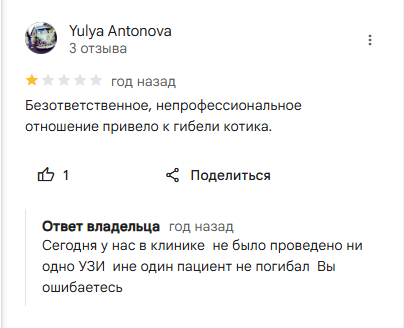
Grammar isn’t the main issue here. The action takes place in Tbilisi (Georgia), and they replied in a non-native language.
What’s wrong here?
- It’s pure denial: word against word.
- Why mention ultrasound here? The review doesn’t even contain that fact.
What should they have done?
- Ask for clarification: who was on shift.
- Which pet it was: cat or dog.
- Investigate the incident — did it happen or not — and then post a second reply in the same review thread with the outcome.
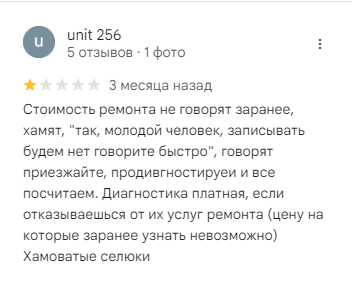
Example of a not-so-good reply to a review from a car repair shop:
The review itself (read here):
And the reply:
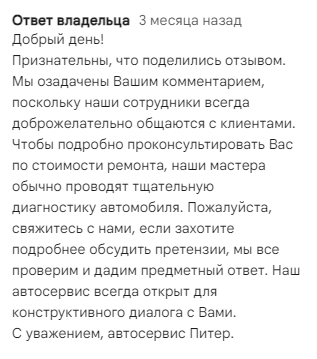
At first glance, what’s wrong? Looks like a decent reply.
But you can reduce it to: “We’re fine. If you want, let’s talk.”
In the space where reviews live, it’s not the original customer who needs this particular shop. It’s everyone reading.
The reader might catch this: if something goes wrong, they will be the one who has to contact the shop and start investigating the incident.
How should it be done?
- Not “if you want,” but “we want to discuss this in detail.”
- Not “contact us,” but “here is the email where we need a message from you so we can identify you in our CRM and discuss your complaint — please describe the date, approximately what time you visited, the car make, and your full name.”
- And add this: “As soon as we identify you and start the investigation, we will also provide a 10% discount on your next visit.” Be careful here: whether you can do this depends on your unit economics.
- After the investigation, publish a short report in the same review thread, or somewhere else: on the website or social media.
Example of how NOT to handle a negative review from a music school:
(read here):
First, a user named Alisa left this kind of review on VK (major Russian social network):

And the owner reacted like this:

As you can probably see:
- She already released her эмоция. He asks for a new round of introspection. That can be done, but not publicly — invite her to DMs.
- He already watched the video and didn’t find the admin rude. His position is already formed. So why ask for a more detailed review?
And then, in that review thread, a public flame war starts. That case has an entire separate article: “How not to handle negative feedback”
How could the review from earlier in the article be handled?
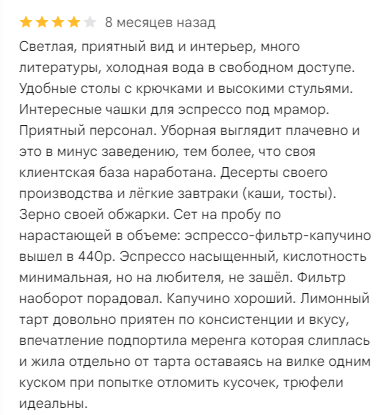
There is no reply there, as you may remember. But it could be something like this:
- You’re right: our restroom isn’t as cozy as it should be. We already scheduled improvements. Roughly, it will be updated by such-and-such date, and until then we keep cleanliness at the required level. Did your “miserable” rating relate more to cleanliness and order? Maybe you were unlucky and came in between cleanings. Email us at <here> so we can better understand your perspective and improve our performance for your next visit!
- About the meringue: we’re genuinely sorry. Food is not only taste, but also texture and consistency. Please contact us via the details above so we can plan your next visit. We will rework the meringue recipe approach, and we’d like a new honest review from you. If we manage to fix the meringue (we will), we’ll set a new standard for how we make it. Your visit will be on us, of course.
A rhetorical question for you, the reader:
How much does an answer like that win you over, with concrete steps forward — both for the customer and for everyone reading?
The more competent you are in replying to negative, semi-negative, almost-negative, almost-positive reviews, the better your conversion progression from readers to customers. First it will be arithmetic, then Fibonacci numbers, then geometric, and in the end it becomes exponential.
Summary:
Reviews are not just words about your product. They are feedback that either strengthens your brand or shows where it wobbles. You can analyse them, use them in sales, and even design them so they work for you.
Key points:
- Negativity is not the enemy. When a customer leaves a negative review, it means they still care. It’s a challenge, and it’s a chance to show how you handle problems. Don’t try to delete negativity — the Streisand effect will show up fast.
- Positivity is trust. Positive reviews strengthen your image. They work best when they are “meaty”: specific details about how the product or service solved a real problem, not just “thanks, everything’s great.”
- OSINT and JTBD.
- OSINT: dig through open sources, analyse reviews about you and competitors, and see what works and what doesn’t.
- JTBD: structure reviews through Jobs To Be Done. For example, “What job were you trying to get done? How did the product help?”
- Reviews across the funnel.
- Awareness: show that you solve problems similar to the reader’s.
- Consideration: give examples of results other people achieved.
- Decision: place trust and outcomes right where the final decision is made.
- Retention: use reviews to help customers come back again (like the meringue example).
- Designing the review. Ask customers questions that reveal real experience: “What surprised you? What became easier because of us?”
Conclusion:
Reviews are an asset. Even negative comments can be turned to your advantage. Understand their logic, build a solid process, and don’t be afraid to look real. Customers return to the place where they feel heard.
That’s all, folks!