
Value Exchange Ecosystem
Spoiler: Value Exchange Ecosystem is a working term for studying a brand and its audience as a single system in which value is exchanged and converted in both directions. It is not only about money, although money is how everything is ultimately measured.
Preface
There is a familiar stereotype that marketers exist to push things people do not need.
I know — that is a layperson’s view. Anyone who starts running a business already understands the value of marketing and marketers. Or denies it. In Marketing A to Z, Philip Kotler draws roughly the same distinction between leaders: those who understand the importance of marketing, and those who do not.
So what am I trying to say here?
My moral and ethical position was expressed long ago by the brilliant Soviet science-fiction writers Arkady and Boris Strugatsky in Roadside Picnic:
“HAPPINESS FOR EVERYBODY, FREE, AND LET NO ONE GO AWAY UNSATISFIED!”
And after ethics comes the craft.
1. Marketing as Working with Abstractions
1.1. You Can’t Touch a Conversion
In my work, what matters most is the end result. And that result comes from working intelligently with the layers of abstraction involved in creating it. Almost everything in marketing is ephemeral: you cannot touch it or find a proper physical referent for it.
Try touching a conversion. I can touch a mug. But a conversion from an impression to a click, from a click to a lead, or from a lead to a sale? I can’t.
The entity we call a “conversion” exists only as an abstraction and a mathematical expression, with interpretations that can get rather solipsistic. This message from person A qualifies, in my interpretation, as an instance of the abstraction “lead”; my client disagrees. Only after we agree on the interpretation do we assign it the abstract value of “one.” Then we add all those ones together, get another number, divide one by the other, multiply by 100, and arrive at a conversion rate expressed as a percentage.
1.2. The Funnel as a Visual Map
This is where the need to visually map both the process and its result comes from. Traditionally, that role is played by the conversion funnel.
A sort of trapezoid-shaped entity through which the people we have agreed to label as “leads” supposedly move from one abstract step to the next. In reality, money moves from one group of people to another—the latter being our clients.

And this orchestra of abstractions is what we have to work with to create a result.
The funnel is a convenient model—until you start seeing how people actually move through it.
2. How the Funnel Began Its Journey Toward a Graph
2.1. A Framework Shapes the Way You Think
Strictly speaking, nothing starts cracking at this point. The logic of the conversion funnel worked, works, and will keep working. If we are being playful about it, HubSpot is to blame here for the way they articulated the conversion-funnel metaphor in their Inbound Methodology course.
They introduced the Flywheel metaphor, explaining how a conversion flywheel works, how momentum builds within that metaphor, and what drives it. The flywheel metaphor proposed a mechanism of rotation built around three elements: attract, engage, delight.
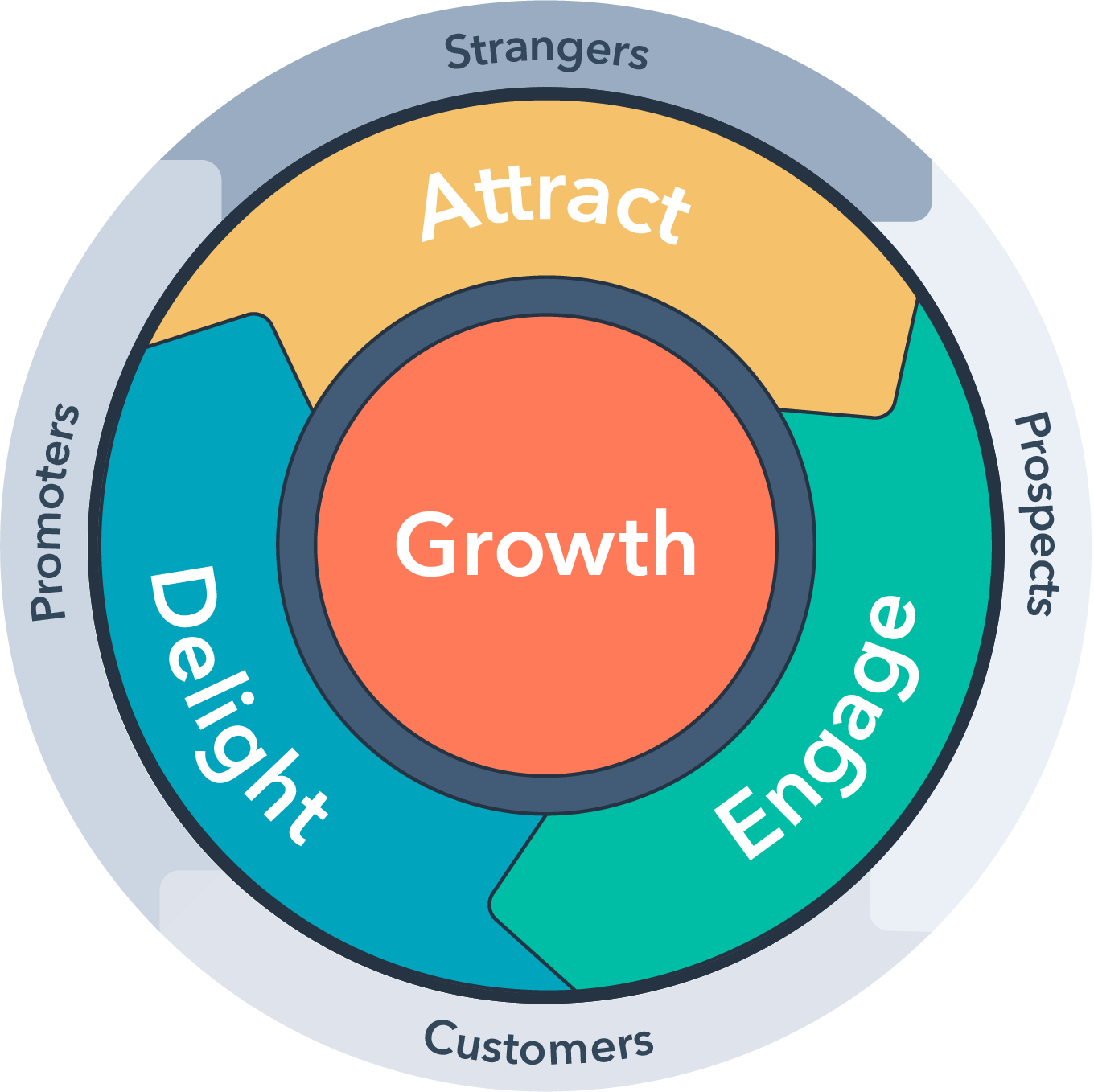
The core idea is this: the way you think about a process determines how you organize it.
That is why I am not trying to fix anything with my new term. There is nothing wrong with the customer journey, the chain of touchpoints, or any other term from marketing, growth marketing, and promotion. The issue does not arise from criticizing those terms and approaches in principle. The problem lies in the frame of thought they impose.
When we do our work, we have a POV on that work. We develop professional blind spots, and the more we practice, the more we describe everything in terms that grow out of those blind spots and reinforce them.
None of this means there will be no result, or that a result cannot be created. It simply means that, in my view, this produces a constrained model of decision-making, because the decision-making frame itself becomes distorted by professional habit.
There is, for example, a wonderful way to work with the problems of your own POV: The Buyer’s Journey. The foundation of that concept is the client’s point of view.
Their path.
But even here, we still classify that path in terms of Awareness, Consideration, and Decision, and to newcomers this concept may look like just another conversion-funnel model, even though it is nothing of the kind.
The turning point for me was trying to depict the customer journey in a more accurate graphic form.
2.2. Attractors and Digital Infrastructure
Ladies and gentlemen, this may sound naive, but I tried to imagine the conversion funnel as a graph. By now, more than a hundred projects have passed through my hands, and across all of them I kept noticing that producing a result requires building a system of touchpoints within this “funnel.”
I had also listened to Robert Sapolsky’s lecture on emergence and complexity at least three times, and then something clicked in my head: this system of touchpoints is a system of attractors. The situation strongly resembles the traveling salesman problem—or the route-finding behavior of foraging ants.
In marketing and promotion, we are constantly creating attractors. Here we break through banner blindness. Here we communicate value through an offer. Here we lead someone to a landing page that may contain another attractor—an FAQ, for example—to qualify the lead further.
All these actions, targeting efforts, and retargeting efforts create nodes between which a potential customer moves with their needs. And the more efficient the route is from the customer’s own perspective—the perspective of The Buyer’s Journey—the more stable the outcome of the “conversion funnel” becomes. In essence, it is less a funnel than a graph.
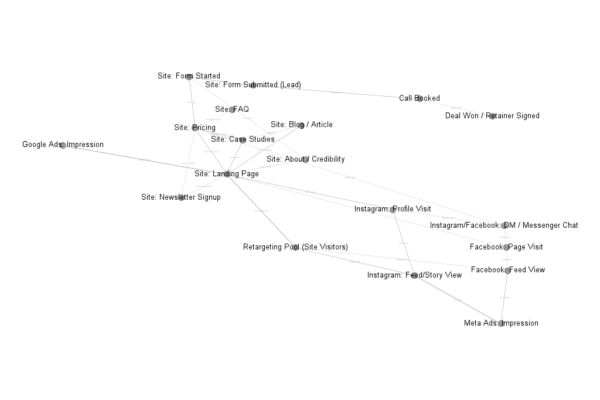
If we draw this graph, analyze the funnel as a graph, and assess how much traffic each node receives, the conversion funnel seems to gain a chance to become more stable and deliver leads like water from a tap.
Turn on the tap — leads start flowing. Turn it off — no leads.
For this picture to hold, we do not even need one specific example. All the analytics and traffic-acquisition tools available to us already provide the means to build exactly this kind of touchpoint system in the form of a graph.
Take Google Analytics: it tracks return visits and the sources that brought people to the website. Then there are Meta Pixel, Twitter Pixel, TikTok Pixel, and so on. This is one of the standard strategies and tactics: everyone who visited the website within a given period is later reached again through retargeting on social media.
Digital infrastructure had been telling me this for years. I just finally thought to draw it as a graph. I am sure people have drawn it this way a million times before me. Once again, I am not breaking new ground here. What may be new, I will unpack a little later.
After all, the graph is still only the form.
3. Why the Term Value Exchange Ecosystem Emerged
3.1. Customer Agency and the Buyer’s Journey
I should note separately that, as I search for and try to work with this term and the entity behind it, I find its ethical position appealing. I am not deliberately building any ethics into it. I simply like the way it distances itself from all those active-voice formulations in the spirit of “how to run the universe without attracting the attention of the orderlies.”
I mean situations where sales managers say, “I closed them,” “I brought them in,” or “I pushed them over the line.” On the one hand, they really do take active steps toward that outcome. Formally, in the CRM, the lead becomes closed-won and moves into that status through their efforts. But at that moment, the agency of the person buying the product seems to disappear.
There are, after all, business owners who think they have grabbed God by the beard, while failing to account for the fact that they operate in a market with wildly resilient and renewable demand.
As a way of thinking, VEE helps keep your ego from growing a crown.
Two strategic marketing concepts fundamentally rewired my thinking: The Buyer’s Journey and JTBD.
The first taught me that the customer journey follows a phase-based logic.
There are no buttons.
And, in a sense, there is no trapezoid either.
There are three approximate stages—or phases—distinguished by what already exists in a potential customer’s mind: do they know the term or name for their problem, or not yet? Or are they already comparing whom to buy from?
Awareness → Consideration → Decision
Between these three phases lies an enormous range of shades, while information arriving from different directions gradually clarifies the route toward the business goal. The greatest value lies in the fact that it is not so much the business that builds a conversion funnel as the conversion funnel that serves the buyer’s journey.
Jobs To Be Done made it possible to move away from the familiar paradigm of profiling a target audience by sex, age, geography, and social category, shifting the conversation toward decomposing the job the business helps the customer get done.
Socio-demographic data helps focus attention on where to look for demand, while JTBD helps deepen the causal logic of the buyer’s route — The Buyer’s Journey.
And while TBJ can still be visualized as a “conversion funnel,” even if that would be inaccurate, JTBD explicitly creates a multi-peaked structure of buyer needs and decomposes demand into its underlying causes. There is no “funnel” here.
Another important thing to understand about the term as a direction for research is that, very often—if not almost everywhere—demand shapes supply.
3.2. A Provisional Term and the Research Horizon
There is a familiar phrase: “demand creates supply.” At first glance, it sounds as though there was no supply, then demand appeared—and supply emerged to meet it. As though demand were some kind of magic card hidden up a sleeve.
And yet, you would struggle to find a single B2B salesperson or high-ticket B2C salesperson who has not seen, through their own professional experience, exactly how demand creates supply.
First, a buyer has “Need A,” and many market players enter the market offering ways to satisfy “Need A.” Or believing that they satisfy it. In essence, the most important thing is that the need is met by the offer well enough for the customer to decide to buy the product.
Then whoever is first to seek feedback on how closely the offer matches the demand begins reshaping the offer to achieve a more accurate fit.
And then the next kind of chemistry emerges: demand itself begins to change. Customers gain experience satisfying the need through already optimized and customized offers, creating another turn in the evolution of supply in response to the evolution of demand.
B2B and high-ticket B2C salespeople will never sell much of anything unless they tailor the offer to the individual shape of a particular client’s demand.
And so, the evolution of supply and demand has been playing ping-pong for centuries. You could even draw the familiar march-of-human-evolution illustration—only this time, the figures would be influencing one another’s evolution from generation to generation.
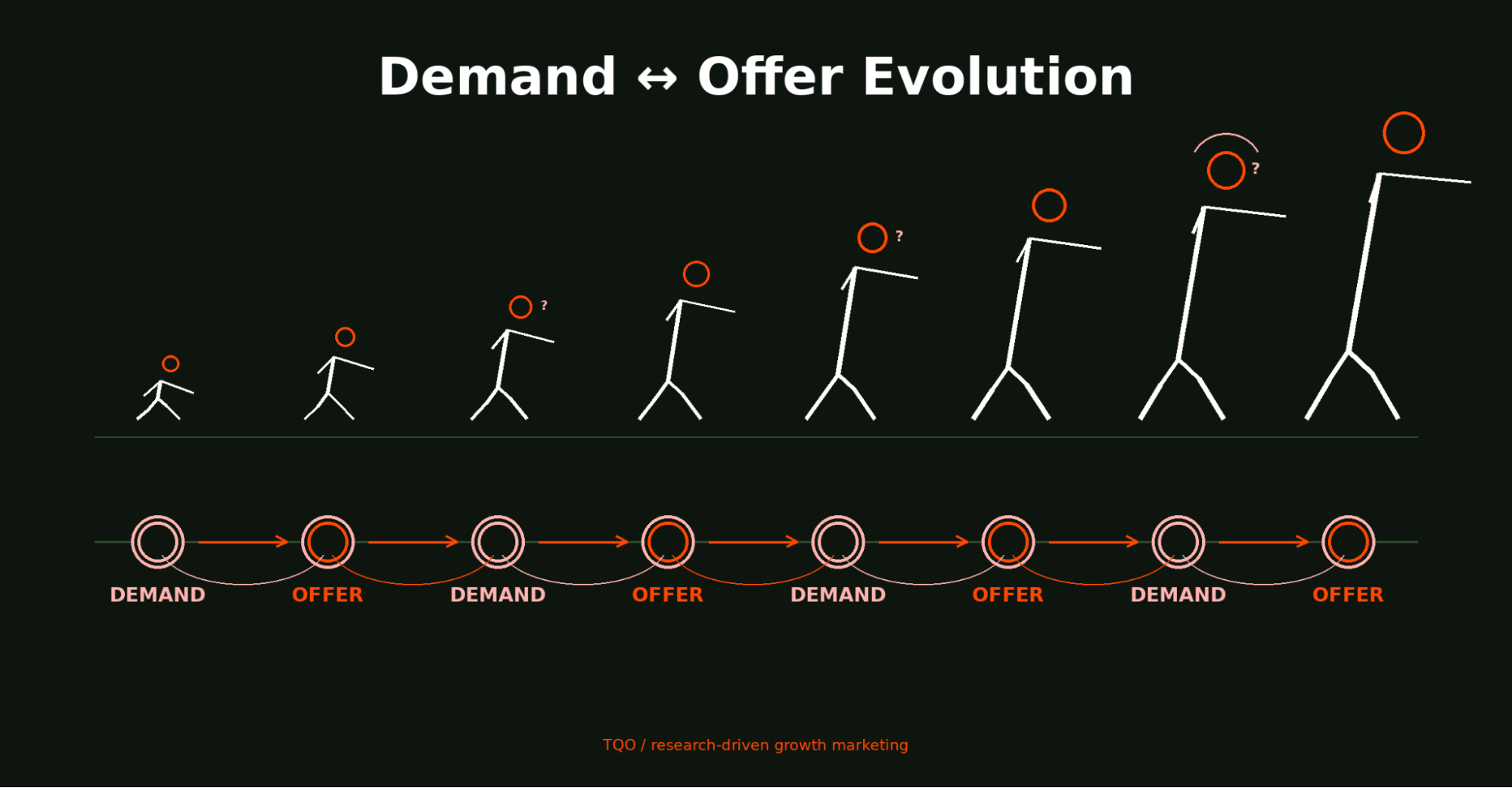
This points to an anthropological ecosystem of value exchange. If we try to describe it in relation to a particular business or brand and place it within a marketing frame, we arrive at a term such as Value Exchange Ecosystem.
The problem with my term is that it comes from not knowing enough about the world. I have encountered examples like this before.
When I first worked in the adult industry, I learned about the term “whale,” which had migrated there from the casino industry. Across most of marketing, the same type of customer would be described as a high-value client.
Why did the term emerge there? Because people needed a name for the entity, while the industry was not exactly a place for “respectable” professionals. By now, all the smart people know the more accurate term — but “whale” has become part of the industry’s cultural and traditional jargon.
I once had a similar case myself: I did not know the term seed audience, so I used the phrase “profile for a Lookalike Audience.”
This happens everywhere. Even marketing contains many terms that partly duplicate one another. And when people lack the underlying knowledge, they very easily confuse Buyer’s Journey with Customer Journey.
I need a focal point for my thinking, so I can understand what I am drawing all my research toward. So that I can first understand what I am looking for and why. And so that I have a way to share it with others and invite critical feedback from the global marketing and business community.
As a vector, then, my term may simply be multiplying entities beyond necessity. That is why one of the goals of this research is either to sink the term and find a more accurate one to which I can attach my operational machinery — much as ODI became the working machinery around jobs and outcomes — or to let the term survive if it proves to be a precise focal point.
If VEE begins to be used across marketing, advertising, and business, it means the term has proved to be a useful focal point. It would be as though JTBD swallowed ODI whole — or ODI swallowed JTBD whole.
The adult-industry example above is a case of convergent evolution of thought. It is entirely possible that, once I learn more about adaptive systems theory, I will simply realize that all of this has already been invented.
At that point, I will not be disappointed. I will understand that I found the right solution—that I felt my way toward the right direction for my own development.
When you suddenly realize that you have reinvented the wheel, you do not end up with a worthless invention—you gain the knowledge that you genuinely understand something about wheels and are competent in the field.
This matters to me for another reason: I have been self-taught all my life. The heroes in my pantheon are Konstantin Tsiolkovsky (Russian pioneer of astronautics), Faraday, Eminem, and Bradbury. These are people who studied the world and reached the summits of their own paths not because someone had taught them how.
But now we can strip the term of its romantic aura.
4. What Value Exchange Ecosystem Means in Practice
Let me explain it one more time, as simply as possible, so it is easier to understand what I am trying to understand.
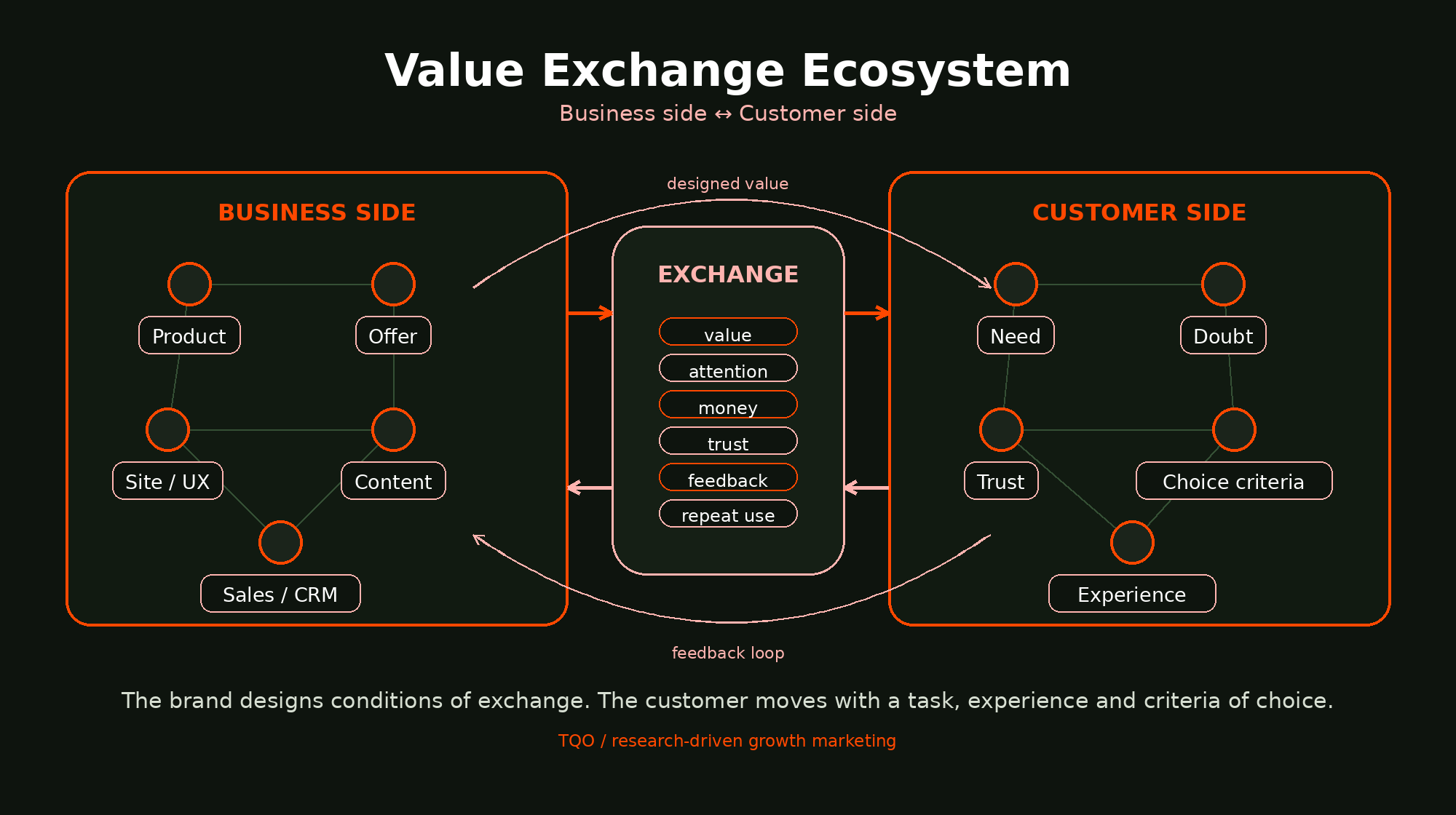
Value Exchange Ecosystem is an attempt to describe a system in which a brand and its audience dynamically influence one another’s values. Roughly speaking, it is an attempt to describe macroeconomics and modern behavioral economics as one unified system at the micro level: “a brand and its audience.”
And then to dock an operational layer onto it.
Whether it will work — and what form it will ultimately take —hell knows. But I am deeply curious to see what comes out of this research campaign.
4.1. The Business Side and the Customer Side
To give you a concrete sense of the familiar entities and functions I am talking about, think of it this way:
Just as a person’s upbringing lives within their cognitive system, rooted in the brain and its neurons, VEE lives in brand strategy, TOV, advertising, content, service, analytics, websites, products, offers, social media, and communities—across every platform owned by or affiliated with a particular business.
But that is not the whole picture. VEE also has a customer side.
Naturally, this includes the customer’s needs, doubts, and sales objections; their life experience and experience as a consumer; their level of expertise with the product; their generational worldview; and their current life context.
These are the things that create the landscape from which needs emerge and shape the direction in which customers search for ways to satisfy them.
In other words, they shape the customer’s route toward a solution—and toward a provider of that solution.
4.2. Value Exchange and Its Practical Value
And why Value Exchange? Because when this almost alchemical connection occurs, a person gives, in exchange for the product, a conventionally high-value abstraction: money.
Along with money, they also provide validation that the product is needed; a sense of purpose and self-realization for the people behind it—the knowledge that they did not spend a part of their priceless lives for nothing.
And, of course, they provide feedback through reviews. That feedback becomes another brick shaping the evolution of the offer.
When a customer raises objections to a purchase, that, too, is an exchange of value. The business made an offer and learned either that it was speaking to the wrong audience or that there is room to evolve the offer faster because it is missing demand by a wide margin.
This is the value I am trying to offer business owners, product professionals, and marketers: to look at a business—and at its marketing and business strategy—as a way to create an ecosystem of value exchange. The more alive and dynamic the system becomes, both in the frequency and volume of exchanges, the more qualitative phase transitions and evolutionary shifts it can go through together with its audience—revealing mysteries of human need that neither fairy tale nor pen could fully describe.
And honestly, I cannot promise that everything will suddenly become clear tomorrow. Tomorrow will bring more of my research. I do not know how long it will take. Maybe everything will click in six months. Maybe in a year. What I can promise is that following my content and my work will be interesting.
And finally, for the sake of precision, here is the difference between a “conversion funnel” and this “value exchange ecosystem”:
“A conversion funnel” helps us think about customer acquisition.
“A value exchange ecosystem” helps us think about the architectural integrity of a business and its customers — a system in which value is generated for both sides. The arrival of customers is not the goal there, but a means. Much like “the wealthy” are fond of saying that money is not the goal, but a means.
And if it is an ecosystem, it must be able to grow somehow.
5. Growth Systems & Measurable Growth
5.1. Growth System as a Cycle
So, if you search for “growth system,” you will find definitions along roughly these lines:
In standard market language, a growth system is a repeatable system for creating growth.
Sean Ellis frames this logic as the search for scalable, repeatable, and sustainable ways to grow—ways of creating growth that can be scaled, repeated, and sustained over time. Here, growth emerges from discipline: gather ideas, prioritize them, test them, examine the data, keep the drivers that work, discard the ones that do not, and repeat the cycle.
If you have read everything I described above, you can probably already feel the rigorous business mechanics compressed into this summary. And that is great. Sean Ellis is the kind of professional I still have to grow into.
And this short summary mirrors one of the central emergent rules almost exactly: attractors multiplied by cycles.
Literally, it is a model of beneficial mutations and natural selection within the modern evolutionary synthesis.
If the principle “this way, fewer things get killed off” were an engineer, it would be a growth cycle—and artificial selection would take the place of natural selection. In essence, that is exactly what it is: artificial selection.
Look at the diversity of dog and cat breeds, as well as cultivated crops. All of them were bred through this kind of “growth cycle.”
There it is: the convergent evolution of thought. A timeless principle described in “business language.”
We see this kind of growth here and there — everywhere across our biome. Life itself has repeatedly recovered through this kind of “growth method,” from one mass extinction to another.
Reforge develops a closely related idea through growth loops. Its central question is:
“How does your product grow?”
And when a team has no shared answer, it begins pulling different parts of the system in different directions. A growth loop is a closed cycle in which the output of one iteration feeds back into the input of the next.
For example: a user creates content; that content attracts new users; those new users create more content. Or a customer receives value, recommends the product, the recommendation brings in a new customer, and the cycle repeats.
As you can see, it is the same beast — just viewed from the side rather than head-on. And once again, this is sound, professional business and marketing logic. It resembles the classic example of the emergent principle known as the wisdom of crowds: one person may misjudge the weight of an ox at a fair, while the average of the crowd’s independent estimates can turn out to be remarkably accurate.
When a team looks in the same direction, it creates a strong attractor — and from there, Sean Ellis’s logic repeats itself.
HubSpot expresses a similar — if not identical — logic through the Flywheel: growth emerges when a business builds momentum, adds force where it matters, and reduces friction. In this model, customers stop being the endpoint of the process and become a force that helps the business continue growing through repeat purchases, referrals, trust, and loyalty.
That is also what I am talking about. Except here, once again, it is business, business, and business.
And MY problem is that HubSpot is an example of a marketing methodology that proved itself through the company’s own success. So, next to industry behemoths like that — and I mean this without irony — I should probably sit quietly and keep my mouth shut.
Still, Plato is dear to me, but truth is dearer. For now, I can still see open ground for my research.
Within VEE, a growth system is the operational layer of the value exchange ecosystem. Its role is to help us use the simple emergent rules found in the world around us to build a microsociety — one in which we think of the audience as the ecosystem’s second PILLAR rather than its GOAL.
5.2. Measurable Growth and Evidence of Causation
If we are talking about a system, then of course we also need to agree on the essential terms by which it will be measured. Without them, we will have no damn idea how this ecosystem is growing.
As always, that means quantitative and qualitative metrics.
For now, let us skim the surface. I will go deeper in later materials.
Objectives and Key Results, and Goals, of course. We need to deliberately place “attractors” ahead of us, giving us a lens through which to perform artificial selection on outcomes.
Hypotheses, naturally. To grow the system in any direction, we first need some idea of how to reach those Goals. It is hard to see how we could do that without hypotheses.
Those hypotheses should then be structured through a growth methodology — for example, ICE, a simple and effective framework for evaluating and testing hypotheses.
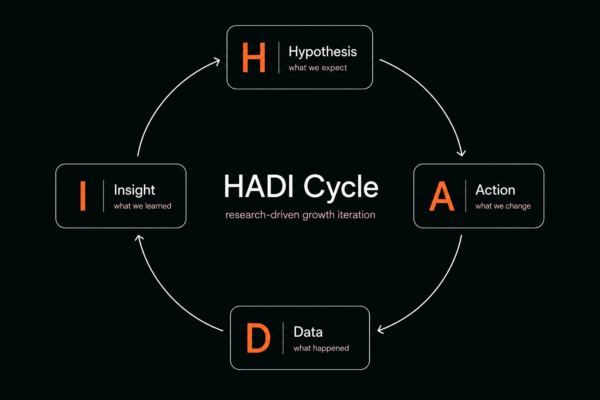
HADI is such a natural cycle that people who have never heard of it often learn about it and feel as though they have already been working that way.
We will also need to count the money. Unit economics is particularly useful here because it allows us to examine financial efficiency inductively — from the individual parts to the whole. A system, after all, is made up of its own gears.
We will also need to develop quantitative and qualitative metrics for intangible effects, drawing on reviews and the concrete experiences of the people who use the business’s products.
One example that comes to mind is a Russian entrepreneur in the hospitality sector who measures business performance partly through how often negative reviews appear and how systematically the business responds to them.
And, of course, we will need analytics platforms to help us see the details within those details.
In my framework, measurable growth is growth that can be taken through a HADI cycle and fed back into the system as data, insights, and the next set of decisions.
Measurable growth begins when a project develops a universe of discourse—a kind of “detective board” that makes it clear what we are dealing with. That board includes a media plan, unit economics, KPI metrics, analytics data, advertising reports, CRM data, OSINT, data mining, interviews, and everything else we can use to map the landscape of the growth system and identify its anchor points.
That is why a defining feature of measurable growth is the ability to identify the causal link between a hypothesis, an action, the data, and the resulting insight. We can say: this is what we hypothesized; this is what we did; this is the data we obtained; this is how it affected the target metric; and this is what we will do next.
The more we tried to challenge our claim of causation — or even destroy it — and the more it survived, the more confidence we can place in the truth of that causal relationship.
This means that the first universal measure of a growth system is the amount of credible evidence for causation. I can already see myself dragging Popper’s criterion of falsifiability into marketing. But not yet.
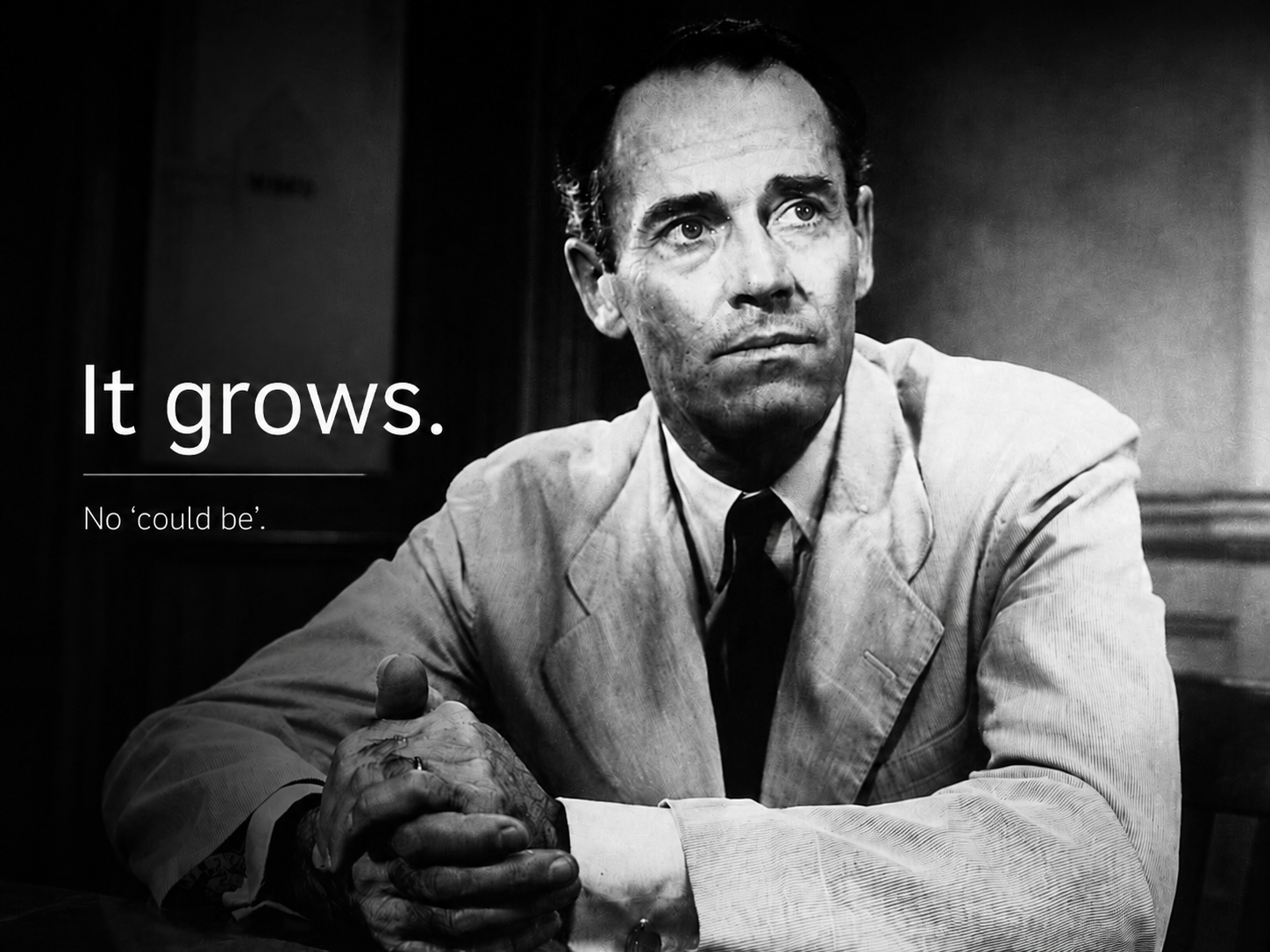
Roughly speaking, metrics alone are not enough. We need all twelve angry men to agree that the system is growing — and even Juror No. 8 to be the first to say that he has no doubts.
Another important indicator is the ability to assess the state of the growth system.
I divide it into unstable, metastable, and stable.
Unstable means leads arrive irregularly, costs fluctuate, forecasting is nearly impossible, and the budget can easily disappear down the drain. There is no reliable way to establish a workable cost-per-lead range.
Metastable means leads are coming in and the approximate range of costs and volumes can already be estimated, but the system still depends heavily on external factors, seasonality, advertising platforms, and individual channel combinations.
Stable means a forecasting range has emerged: we can estimate the likely number of leads and their approximate cost, understand how the system responds to changes, and see where to look for new growth opportunities.
And this is where I can already see something in my own thinking that deserves criticism. Leads are a useful measure of a business’s earning potential when those leads turn into successful deals, but the term does not fully describe the growth system of a value exchange ecosystem.
We need to look for other terms — and for the entities behind them.
Sustainable improvement differs from a temporary spike because it withstands repetition, doubt, and changes in context. One successful advertising creative may produce a sharp outlier spike. A growth system should demonstrate that the effect can be explained, repeated, partially transferred, and incorporated into the next cycle of decisions.
And the ecosystemic nature of this growth system should help answer why repeated attempts have started breaking down and stopped producing results. What pass toward an offer mutation are we missing because we are blind to mutations in demand?
In the future, I expect this framework to develop more terms describing the state of growth across every pillar of such a value exchange system — not only from the business side, as with a term like leads.
It will also include translations of scientific methodologies into business and marketing—such as the evolutionary algorithm of natural selection expressed through the concept of a Growth Loop.
Without the human being inside this ecosystem, however, everything turns back into business machinery.
6. Buyer Journey, JTBD & Customer Research
6.1. Need Comes Before the Market
You see, need has always come before the market—purely in biological and evolutionary terms. Look at our fellow animals: they have no market. A market is a social mechanism for redistributing resources. So when we talk only about the mechanism, it is as though we are shooting ourselves in the foot. Why should we discuss the screwdriver and the screw instead of the actual job they are needed for?
This is the central perspective behind The Buyer’s Journey as a way of describing the customer’s path.
I believe I mentioned this earlier: The Buyer’s Journey is built entirely around the customer’s POV. It tries to describe that journey as a three-part structure.
At the same time, these are not rigid steps, but phases, much like the stages of coming to terms with the inevitable. When films portray someone grieving a loved one, the sequence usually goes something like this: denial today, anger tomorrow, bargaining the day after, then depression, and finally acceptance.
In reality, if something offers even a glimmer of hope after acceptance, the mind may seize on it and return to bargaining.
These are phases, and how people move through them depends on a range of triggers.
The same is EXACTLY true of The Buyer’s Journey. Today, someone may be at a stage — or rather, in the Awareness PHASE — meaning they do not yet know what their problem is called, or how to name the opportunity they are looking for.
Then they learn the term and understand the name of the problem—and that is it: they move into the Consideration stage. In this phase, they compare types of solutions. Later, in the Decision phase, they choose a solution provider.
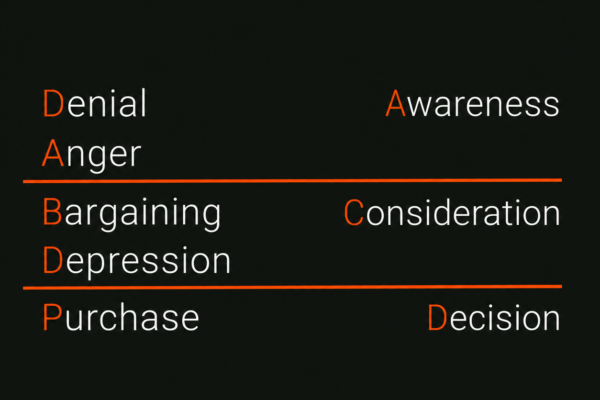
IN REALITY, however, the Awareness stage may pass almost instantly because, under the Dunning–Kruger effect, the person THINKS they understand the problem and rushes off to read blogs about SMM.
But while reading them, they realize that what they probably need is paid traffic. So they move from Consideration back to Awareness, and then return to Consideration.
Then they choose an agency and buy its services — meaning they have completed the Decision phase—only to discover that what they actually needed was brand strategy.
This is where JTBD enters the picture: an approach that begins by focusing on the outcome of the customer’s journey — the job that needs to be done.
It is probably one of the most progressive concepts in business and marketing strategy. Once you encounter it, it becomes hard to understand how the hell we thought BEFORE it — or why we did not think this way from the start.
These two acrobatic brothers are, in essence, entirely about the potential buyer’s POV. Together, they can help us design a customer journey within a single ecosystem—one that is more likely to compensate for the buyer’s inevitable lack of knowledge by rapidly reducing the information asymmetry between what the customer knows about their problem and what they know about which offers actually solve it, and how.
And an important clarification: this is not a judgment of the buyer. In life, we are all underdeveloped in different ways and to different degrees. In one situation, someone may be an expert. In another, they may be helplessly feeling their way through unfamiliar terms, other people’s promises, advice from friends, advertising offers, and their own mistaken assumptions. A buyer is not required to be an expert in a market they entered because they had a job to get done.
But they will become one.
That is why a healthy marketing system should help people understand more quickly what is happening to them, what type of solution they need, and which criteria they should use to choose a provider.
6.2. Current Life Context
More than anything, we need to capture the customer’s current life context. Alongside all the traditional marketing inputs: barriers, decision criteria, reasons for rejection, and the cost of making the wrong choice. In JTBD methodology, Ulwick alone devotes a hell of a lot of attention to operational methods for uncovering every type of job through quantitative and qualitative research, and to constructing the Core Functional Job, Job Map, and so on. Meanwhile, Neil Rackham had already hinted at the situational system behind customer needs in SPIN Selling.
He described selling some kind of software that would reduce errors in client reports. As a result, the person responsible would spend less time checking them and have more time for strategic business tasks.
Something like that. This is not an exact retelling.
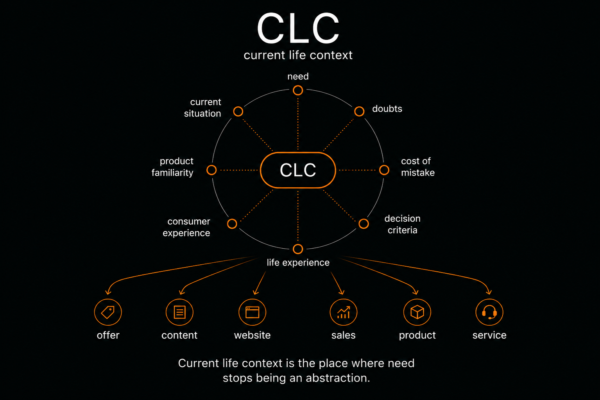
Human needs work like dominoes, and they always form dense clusters within each person’s current life context. If this context is consistently captured, analyzed, and recorded, we will begin to see the estuaries and deltas of what I call VEE.
Naturally, once current life context is recorded, it creates 1,001 opportunities to speak to customers about it directly — to show them that the business is paying close attention to them and thinking carefully about them. Few people dislike being treated with care and attention.
And when people are grateful to other people, they share far more than money. That, you could say, is the precursor to value exchange.
That said, if you think about it more carefully, you will find very few businesses that do not try to account for this. In saturated markets with fierce competition, almost every conceivable way of capturing context already exists.
But this is creative work, and it requires continuous, systematic effort. There is no ceiling here.
In Marketing A to Z, Philip Kotler gives a revealing example: Japanese automakers sent employees to observe American women loading groceries into their trunks in supermarket parking lots.
They redesigned the trunk with mothers in mind, making it easier for them to use.
In other words, they had accounted for the customer’s current life context.
It is hard to imagine modern marketing without a solid understanding of the buyer’s journey and the customer’s job—yet such marketing exists. You find it in industries with wildly resilient demand, where the product is so sought after that you can switch your brain off for years and never analyze the journey or the job.
I saw this problem with my own eyes. One souvenir and merchandise brand could not understand why sales were sluggish on social media while doing well on marketplaces. There was simply no understanding that, if they wanted to grow beyond marketplaces, they needed to create and uncover additional sources of value together with their audience—rather than remain a supplier of branded merchandise based on various anime franchises and Harry Potter, which was precisely what had carried them on marketplaces.
At its core, this entire chapter — and this branch of the framework going forward — will be devoted to the customer’s POV and the methods used to describe it.
To the nuances of The Buyer’s Journey, different ways of describing a Buyer Persona, working with reviews, and so on and so forth.
Now we need to ground the customer side in concrete routes.
7. Demand Capture & Conversion Infrastructure
This branch of VEE is responsible for the practical infrastructure through which people enter the ecosystem.
Buyer’s Journey, JTBD, and customer research help us understand what is happening to a person: which phase they are in, what job they are trying to get done, which words they use, what they fear, which criteria guide their choices, and where they may be mistaken.
Demand capture, search intent, SEO, Google Ads, paid social, retargeting, landing pages, forms, analytics, and CRM answer a different question: how does this understanding become a set of routes through which people enter a business’s orbit?
Search intent, in this framework, is the SEO translation of the buyer’s journey and JTBD. A person’s search query reveals how their job, phase, level of understanding, and readiness to act have surfaced in the search bar. If someone searches “why isn’t my advertising generating leads?”, that is one type of entry point. If they search “growth marketing agency pricing,” that is another. If they search for a competitor by name or type “alternative to…”, they have already reached the most direct layer of demand capture.
That is why there is little value in expanding this branch separately from Buyer’s Journey and JTBD. It serves as the technical layer for capturing and routing demand: which pages to create, which ads to launch, which search queries to address, which comparison pages to build, where to direct people, how to re-engage them after the first touchpoint, and where to measure whether the system is once again losing value exchange.
As you can see, this section is still relatively empty, even though there is plenty to talk about. I simply need to think through the angle from which to tell that story now. Still, let it be announced already.
And with that, the first rough framework of VEE is complete.
8. How This Page Will Evolve
First, yes, this is a manifesto—and a rather beautiful one at that. But it is less about me having discovered some brilliant idea and more about self-manifestation: a declaration that I intend to become a serious figure in the industry. This is no picnic—conducting this kind of research and systematization while facing the very real possibility of discovering absolutely nothing new.
Still, I am confident that I will at least uncover an interesting operational method.
Second, yes, this page will evolve into a methodology hub. That opens up a whole freight train of reasons to share my working methodology and create a common space for discussion.
Third, yes, the page will be updated periodically as I refine and substantiate the ideas it is built on—and add new ones.
Over time, other articles will link here, and I will link from here to my own case studies, observations, book and research notes, tool reviews, methodological conclusions, mistakes, and revisions to the term as it continues to evolve.
And part of the content will be devoted to debunking myths in our profession, such as the shadow ban, because these myths interfere with identifying causation correctly.
They interfere with establishing what can actually be trusted.
Let me explain this once more: the provisional nature of the term Value Exchange Ecosystem is really about whether it will become a new methodological concept in its own right, alongside something like The Buyer’s Journey, or whether it will become something closer to Tony Ulwick’s ODI within the broader JTBD approach.
In my case, the term itself could easily turn out to be replaceable by Service-Dominant Logic, Customer Experience Management, Customer Journey Orchestration, or Customer Lifecycle Marketing.
Growth Systems addresses how the ecosystem grows, tests hypotheses, accumulates data, and moves from chaos toward a more stable state.
Buyer Journey / JTBD addresses the customer side: how people become aware of a need, what job they are trying to get done, which doubts they move through, and which criteria they use to choose a solution.
Demand Capture & Conversion Infrastructure addresses the entry gateways and routes: where demand has already surfaced, how a business captures that demand, where it directs people, and where value exchange may be lost.
Together, these branches will refine VEE from three directions: system growth, customer logic, and demand-capture infrastructure.
We will be able to judge the progress of this research by whether a robust theoretical foundation for describing VEE emerges—and whether that description proves distinct enough that no other term can replace it.
Tools for creating, developing, and understanding this ecosystem will also begin to emerge, including through maturity stages. Different kinds of To-Dos for building and developing it. All the way to software prototypes. Thanks to vibe coding for that.
Compressed into a few short arrows, the whole thing looks like this.
9. FAQ
9.1. What Is Value Exchange Ecosystem?
Value Exchange Ecosystem is a way of looking at marketing as a living system of value exchange between a business and its audience—one in which the product, demand, trust, the customer journey, and the logic of growth itself all evolve.
9.2. How Is VEE Different from a Conversion Funnel?
A conversion funnel helps us measure movement toward conversion. VEE helps us see the environment that makes this movement possible in the first place.
9.3. How Is VEE Different from Customer Journey or Buyer’s Journey?
Buyer’s Journey describes the buyer’s path. VEE describes the ecosystem in which that path emerges, breaks down, accelerates, loops back, and reshapes the business itself.
9.4. How Is VEE Related to JTBD?
JTBD reveals the job that brings a person into the market. VEE looks at how value exchange emerges around that job—between the person, the business, and the offer.
9.5. How Is VEE Related to Growth Marketing?
Growth marketing provides the cycles for testing and growth. VEE asks what exactly is growing: numbers in a report, or a living system of value exchange.
9.6. Can VEE Already Be Used as a Complete Methodology?
At this stage, VEE can be used as a framework for thinking, diagnosis, and research. It will become a complete methodology only if it withstands practice, criticism, and repetition.
9.7. Why Is TQO Introducing This Term at All When Service-Dominant Logic, Customer Journey, JTBD, Growth Loops, and Other Concepts Already Exist?
Because TQO needs a focal point for assembling these approaches into a single working map. If the term is redundant, it will sink. If it is precise, it will become a tool.
For now, I invite you to watch this unfold. To begin with, subscribe to the blogs wherever it is most convenient for you. Bookmark the website.
And from there, we’ll see where it leads.